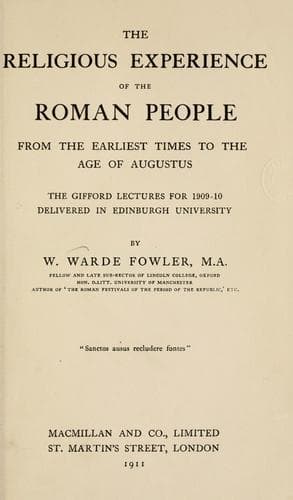
The Religious Experience of the Roman People: From the Earliest Times to the Age of AugustusFowler, W. Warde (William Warde)
Religion
The Religious Experience of the Roman People: From the Earliest Times to the Age of Augustus
Fowler, W. Warde (William Warde)
Cults -- Rome; Rome -- Religion
Another point, closely connected with the last, and tending in the same
direction, is that such a calendar as this implies rigidity and routine
in religious duties. A well-ordered city life under a strong government
must, of course, be subject to routine; law, religious or civil, written
or unwritten, forces the individual into certain stereotyped ways of
life, subjects him to a certain amount of wholesome discipline. The
value of such routine to an undisciplined people has been well pointed
out by Bishop Stubbs, in writing of the effect of the rule of the Norman
and Angevin kings on the English people,[205] where it was also a
religious as well as a legal discipline that was at work. In neither
case was it the ignorant and superstitious routine of savage life, which
of late years we have had to substitute for old fancies about the
freedom of the savage; it is the willing obedience of civilised man for
his own benefit. But if it means a routine of religious rites which are
beginning to lose their meaning; if the relation between them and man's
life and work is lost; and lastly, if, as was probably the case, the
Fasti were not published, but remained in the hands of a priesthood or
an aristocracy,[206]--then there is serious loss as well as gain. You
begin sooner or later to cease to feel your dependence on the divine
beings around you for your daily bread, to get out of right relation
with the Power manifesting itself in the universe.
But, in the third place, we must believe that at first, and indeed
perhaps for ages, this very routine had an important psychological
result in producing increased comfort, convenience, and confidence in
the Roman's relations with the divine inhabitants of his city. A certain
number of deities have taken up their abode within the walls of the
city, and are as much its inhabitants, its citizens, as the human beings
who live there; and all the relations between the divine and human
citizens are regulated now by law, by a _ius divinum_, of which the
calendar is a very important part. _Religio_, the old feeling of doubt
and scruple, arising from want of knowledge in the individual, is still
there; it is, in fact, the feeling which has given rise to all this
organisation and routine, the _cura_ and _caerimonia_, as Cicero phrases
it. But it must be already losing its strength, its life; it was, so to
speak, a constitutional weakness, and the _ius divinum_ is already
beginning to act on it as a tonic. Doubt has passed into fixed usage,
tradition has given place to organisation. Time, place, procedure in all
religious matters, are guaranteed by those skilled in the _ius divinum_;
they know what to do as the festival of each deity comes round, and at
the right time and place they do it with scrupulous attention to every
detail. Thus the organisation of which the calendar is our best example
would have as its first result the destruction of fear and doubt in the
Public-domain text, read in full here on John Shaqi.
Reviews
Reviews
No reviews yet
Be the first to share your thoughts on this work.
Elsewhere in the archive
Join the Discussion
Join the discussion
Sign in to leave a comment or review.
Sign InorCreate an account