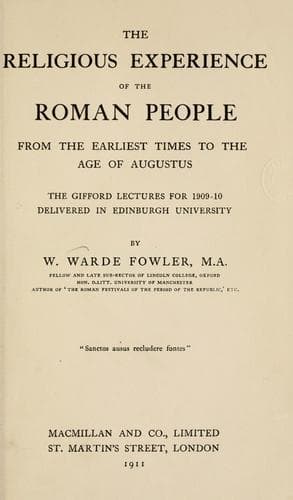
The Religious Experience of the Roman People: From the Earliest Times to the Age of AugustusFowler, W. Warde (William Warde)
Religion
The Religious Experience of the Roman People: From the Earliest Times to the Age of Augustus
Fowler, W. Warde (William Warde)
Cults -- Rome; Rome -- Religion
[203] Varro, _L.L._ v. 64, says, "Ab _satu_ dictus
Saturnus." And in Augustine (_Civ. Dei_, vi. 8) he is
quoted as holding the opinion "quod pertineat Saturnus
ad semina, quae in terram de qua oriuntur iterum
recidunt." He was probably the _numen_ of the
seed-sowing (Saeturnus), and as his festival comes
after the end of sowing, we may presume that he was the
_numen_ of the sown as well as of the unsown seed. In
the article "Saturnus" in Roscher's _Lexicon_, which has
appeared since the above note was written, Wissowa
provisionally accepts Varro's etymology.
[204] Festus, p. 245a, "Publica sacra quae publico
sumptu pro populo fiunt, quaeque pro montibus, pagis,
curiis, sacellis." See article "Sacra" in _Dict. of
Antiqq._ ii. 577.
[205] "Routine is the only safeguard of a people under a
perfect autocracy" (_Select Charters_, Introduction, p.
19).
[206] The annalists believed that the publication first
took place in the year 304 B.C.: Livy ix. 46. Mommsen
(_Chronologie_, p. 31) thought it possible that it had
already been done by the Decemvirs in one of the two
last of the XII. Tables, but again withdrawn. The object
of keeping the Fasti secret was, of course, to control
the times available for legal and political business.
[207] This paragraph is abridged from a passage in the
author's paper in the _Hibbert Journal_ for 1907, p.
848.
[208] See _Anthropology and the Classics_ (Oxford,
1908), p. 44.
[209] _R.F._ p. 241 foll.
[210] Wissowa holds that it dates from the third century
B.C.: Pauly-Wissowa, _Real-Encycl._, _s.v._ "Argei." I
endeavoured to refute this view in the _Classical
Review_ for 1902, p. 115 foll., and Dr. Wissowa
criticised my criticism in his _Gesammelte
Abhandlungen_, p. 222. It is dealt with at length in
_R.F._ p. 111 foll. See below, p. 321 foll.
[211] This is not exactly the view expressed in _R.F._
p. 315 foll., where I was inclined to adopt that of
Mannhardt that the laughing symbolised the return to
life after sacrificial death. I am now disposed to think
of it as parallel with the ecstasy of the Pythoness and
other inspired priests, or the shivering and convulsive
movements which denote that a human being is "possessed"
by a god or spirit. See Jevons, _Introduction_, p. 174.
Mannhardt's view seems, however, to gain support from
Pausanias' description of the ordeal he underwent
himself at the cave of Trophonius, after which he could
laugh again: Paus. ix. 39. See also Miss Harrison,
_Prolegomena to the Study of Greek Religion_, p. 580.
Deubner in _Archiv_, 1910, p. 501.
Public-domain text, read in full here on John Shaqi.
Reviews
Reviews
No reviews yet
Be the first to share your thoughts on this work.
Elsewhere in the archive
Join the Discussion
Join the discussion
Sign in to leave a comment or review.
Sign InorCreate an account