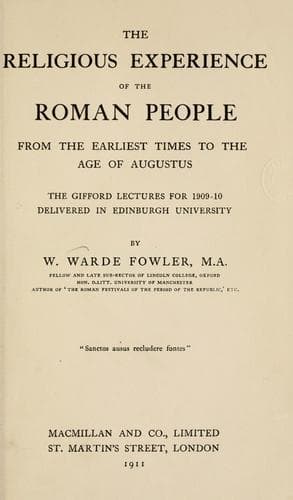
The Religious Experience of the Roman People: From the Earliest Times to the Age of AugustusFowler, W. Warde (William Warde)
Religion
The Religious Experience of the Roman People: From the Earliest Times to the Age of Augustus
Fowler, W. Warde (William Warde)
Cults -- Rome; Rome -- Religion
[191] _R.F._ p. 38 foll. Marindin's article "Salii,"
_Dict. of Antiqq._, is very useful and sensible. There
is little doubt that the dress and armour of the Salii
represented that of the primitive Latin warrior,
calculated to frighten away evil spirits as well as
enemies, and that their dances in procession had some
object of this kind. It is noticeable that there were
two gilds or collegia of them belonging to the Palatine
and Quirinal cities respectively; and they are also
found at Tibur, Alba, Lanuvium, and other Latin cities.
[192] Or 15th (Ides), according to the conjecture of
Wissowa; see _R.F._ p. 44 and _R.K._ p. 131. It is
almost incredible that this should originally have been
on a day of even number, contrary to the universal rule
of the Fasti.
[193] See below, p. 212 foll., for further consideration
of this so-called purification.
[194] _R.K._ p. 131.
[195] See below, p. 217.
[196] _R.K._ p. 131.
[197] _Popular Religion and Folklore of India_, ii. 51.
For the sacredness of the number three and its
multiples, see Diels, _Sibyllinische Blaetter_, p. 40
foll.; but he limits it too much to chthonic religious
ritual. See also H. Usener, "Dreizahl," in _Rheinisches
Museum_, vol. 58, pp. 1 foll., 161 foll., and 321 foll.
There is a summary of the results of these papers in
Gruppe's _Mythologische Literatur_, 1898-1905, p. 360
foll. I may also refer to my friend Prof. Goudy's very
interesting _Trichotomy in Roman Law_ (Oxford, 1910), p.
8 foll.
[198] By von Domaszewski in _Archiv_ for 1907, p. 333
foll. The learned author's reasoning is often based on
mere hypotheses as to the meaning of the festivals or
the gods concerned in them, and his ideas as to the
agricultural features of the months July, August,
December seem to me doubtful; but the paper is one that
all students of the calendar must reckon with.
[199] Marquardt, _Privatleben_, pp. 459 and 569 foll.
[200] For the festivals mentioned in the following
paragraphs see _R.F._, _s.v._, and Wissowa, _R.K._,
section 63.
[201] "St. George and the Parilia," in _Revue des etudes
ethnographiques et sociologiques_ for Jan. 1908. I owe
my knowledge of this admirable study to the kindness of
its author.
[202] Frazer, _G.B._ ii. 318 foll.
Public-domain text, read in full here on John Shaqi.
Reviews
Reviews
No reviews yet
Be the first to share your thoughts on this work.
Elsewhere in the archive
Join the Discussion
Join the discussion
Sign in to leave a comment or review.
Sign InorCreate an account