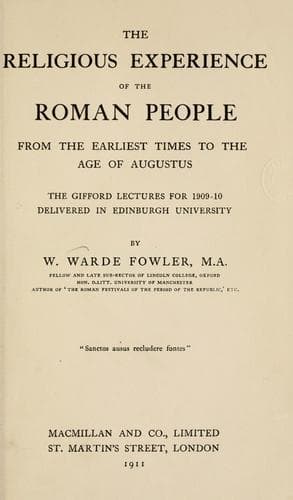
The Religious Experience of the Roman People: From the Earliest Times to the Age of AugustusFowler, W. Warde (William Warde)
Religion
The Religious Experience of the Roman People: From the Earliest Times to the Age of Augustus
Fowler, W. Warde (William Warde)
Cults -- Rome; Rome -- Religion
than Tellus and her Fordicidia, and that the Cerealia should eventually
develop into _ludi_ of no less than eight days' duration. Yet Tellus
survived in such forms as that of the _devotio_; and even under the
Empire we find her as Terra on sepulchral monuments, _e.g._--
ereptam viro et matri mater me Terra recepit,
or
terra mater rerum quod dedit ipsa teget.
And there is a curious story, noticed by Wissowa and by Dieterich after
him, that on the death of Tiberius the plebs shouted not only "Tiberius
in Tiberim," but "Terram matrem deosque Manes," in order that his lot
might be among the _impii_ beneath the earth.[236]
So far we have met with nothing to suggest that the Roman idea of
divinity had passed much beyond an advanced type of animism; we have
found little or no trace of personal deities of a polytheistic cast.
There is, however, a fact of importance now to be considered, which has
some bearing upon this difficult subject. Some of the _numina_ of the
calendar had special priests attached to their cults; _e.g._ among those
I have already mentioned, Volcanus, Furrina, Portunus, and Volturnus, to
which we may now add Pales, Flora, Carmenta, Pomona, and a wholly
unknown deity, Falacer. These nine all had flamines, a word which is
generally derived from _flare_, _i.e._ they were the kindlers of the
sacrificial fire.[237] Sacrificing priests they undoubtedly always were,
each limited to the sacrificial rites of a particular cult, unless
authorised by religious law to undertake those of some other deity whose
name he did not bear, and who was destitute, like Robigus, of a priest
of his own.[238] We have no certain evidence that all these flamines
were of high antiquity; but those attached to deities of the calendar
were probably of earlier origin than that document, and as we have no
record of the creation of a new flaminium in historical times until the
era of Caesar-worship, it is fair to conclude that the others I have
mentioned were not younger.
Public-domain text, read in full here on John Shaqi.
Reviews
Reviews
No reviews yet
Be the first to share your thoughts on this work.
Elsewhere in the archive
Join the Discussion
Join the discussion
Sign in to leave a comment or review.
Sign InorCreate an account