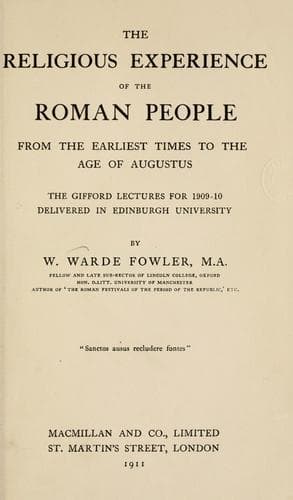
The Religious Experience of the Roman People: From the Earliest Times to the Age of AugustusFowler, W. Warde (William Warde)
Religion
The Religious Experience of the Roman People: From the Earliest Times to the Age of Augustus
Fowler, W. Warde (William Warde)
Cults -- Rome; Rome -- Religion
Now what bearing has this fact on the question as to how the early
Romans conceived the objects of their worship? There are, of course,
so-called priests all the world over, even among the lowest fetishistic
and animistic peoples, who exercise power over the various kinds of
spirits by potent charms and spells; these should rather be called
wizards, medicine-men, magicians, and so on.[239] But the flamines as we
know them were not such; they were officials of a State, entrusted with
the performance of definite ritualistic duties, more particularly with
sacrifice, and therefore, as we may assume from universal Roman practice
so far as we know it, also with prayer. If they did not actually slay
the victims themselves--and in historical times this was done by an
assistant--they superintended the whole process and were responsible for
its correct performance.[240] Does the existence of such priests come
into relation with the development of the idea of a _deus_ out of a
numen or a spirit? What is the influence of the sacrificing priest on
the divinity whom he serves? This last is a question to which it is not
easy to find a ready answer; the history of priesthood, and of the moral
and intellectual results of the institution, has yet to be written. Even
Dr. Westermarck, in his recently published great work on the development
of moral ideas, has little to say of it. It is greatly complicated by
the undoubted fact that among many peoples, perhaps to some extent even
among the Latins, the earliest real priests had a tendency to personate
the deity themselves, to be considered as the deity, or in some sense
divine.[241] But in regard to Roman priests we may, I think, go at least
as far as this. When a spirit was named and localised as a friendly
being at a particular spot within the walls of the city, which is made
over to him, and where he has his _ara_; when the ritual performed at
this spot is laid down in definite detail, and undertaken by an
individual appointed for this purpose by the head of the community with
solemn ceremony; then the spirit, hitherto but vaguely conceived, must
in course of time become individualised. The priestly if not the popular
conception of him is fixed; there is now no question who he is or how he
should be called; "quis deus incertum est"[242] can no longer be said of
him. Once provided with a flamen and an ordered cult of sacrifice and
prayer, I conceive that he had now in him the possibility of turning
into a _deus_ personally conceived, if he came by the chance.[243] A few
did get the chance; others did not; Volcanus, for example, became a god
after the model of the Greek Hephaestus, while Volturnus remained a
numen and made no further progress, though he was doubtless ready to
"take" the Graecising epidemic when it came. I do not say that he or any
other numen was the better for the change. But I must not now pursue the
story of this strange double fate of the old Roman deities; I have
Public-domain text, read in full here on John Shaqi.
Reviews
Reviews
No reviews yet
Be the first to share your thoughts on this work.
Elsewhere in the archive
Join the Discussion
Join the discussion
Sign in to leave a comment or review.
Sign InorCreate an account