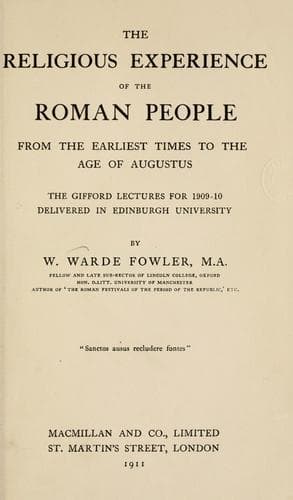
The Religious Experience of the Roman People: From the Earliest Times to the Age of AugustusFowler, W. Warde (William Warde)
Religion
The Religious Experience of the Roman People: From the Earliest Times to the Age of Augustus
Fowler, W. Warde (William Warde)
Cults -- Rome; Rome -- Religion
I do not indeed wish to be understood as maintaining that the religion
of the Roman was the most important element in his mental or civic
development: far from it. I should be the first to concede that the
religious element in the Roman mind was not that part of it which has
left the deepest impress on history, or contributed much, except in
externals, to our modern ideas of the Divine and of worship. It is not,
as Roman law was, the one great contribution of the Roman genius to the
evolution of humanity. But Roman law and Roman religion sprang from the
same root; they were indeed in origin _one and the same thing_.
Religious law was a part of the _ius civile_, and both were originally
administered by the same authority, the Rex. Following the course of the
two side by side for a few centuries, we come upon an astonishing
phenomenon, which I will mention now (it will meet us again) as showing
how far more interest can be aroused in our subject if we are fully
equipped as Roman historians than if we were to study the religion
alone, torn from the living body of the State, and placed on the
dissecting-board by itself. As the State grew in population and
importance, and came into contact, friendly or hostile, with other
peoples, both the religion and the law of the State were called upon to
expand, and they did so. But they did so in different ways; Roman law
expanded _organically_ and intensively, absorbing into its own body the
experience and practice of other peoples, while Roman religion expanded
_mechanically_ and extensively, by taking on the deities and worship of
others _without any organic change of its own being_. Just as the
English language has been able to absorb words of Latin origin, through
its early contact with French, into the very tissue and fibre of its
being, while German has for certain reasons never been able to do this,
but has adopted them as strangers only, without making them its very
own: so Roman law contrived to take into its own being the rules and
practices of strangers, while Roman religion, though it eventually
admitted the ideas and cults of Greeks and others, did so without taking
them by a digestive process into its own system. Had the law of Rome
remained as inelastic as the religion, the Roman people would have
advanced as little in civilisation as those races which embraced the
faith of Islam, with its law and religion alike impermeable to any
change.[3] Here is a phenomenon that at once attracts attention and
suggests questions not easy to answer. Why is it that the Roman religion
can never have the same interest and value for mankind as Roman law? I
hope that we shall find an answer to this question in the course of our
studies: at this moment I only propose it as an example of the advantage
gained for the study of one department of Roman life and thought by a
pretty complete equipment in the knowledge of others.
Public-domain text, read in full here on John Shaqi.
Reviews
Reviews
No reviews yet
Be the first to share your thoughts on this work.
Join the Discussion
Join the discussion
Sign in to leave a comment or review.
Sign InorCreate an account