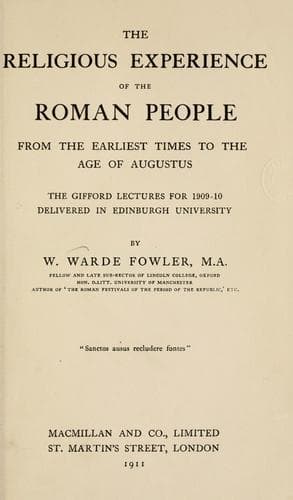
The Religious Experience of the Roman People: From the Earliest Times to the Age of AugustusFowler, W. Warde (William Warde)
Religion
The Religious Experience of the Roman People: From the Earliest Times to the Age of Augustus
Fowler, W. Warde (William Warde)
Cults -- Rome; Rome -- Religion
and needing shelter. But this later and foreign notion of divinity so
completely took possession of the minds of the Romans of the
cosmopolitan city that Varro is the only writer who has preserved the
tradition of the older way of thinking. In the religion of the family
Ovid indeed has charmingly expressed it, perhaps on the authority of
some lost passage of Varro[296]:--
ante focos olim scamnis considere longis
mos erat, et mensae credere adesse deos.
Tibullus in one passage has mentioned what seems to be some rude attempt
to give outward shape and form to an ancient pastoral deity[297]:--
lacte madens illic suberat Pan ilicis umbrae
et facta agresti lignea falce Pales.
And Propertius hints at a like representation of Vertumnus, the garden
deity. But without some corroborative evidence it is hardly safe to take
these as genuine examples of early iconic worship.
Thus we may take it as certain that even the greater deities of the
calendar, Janus, Jupiter, Mars, Quirinus, and Vesta, were not thought of
as existing in any sense in human form, nor as personal beings having
any human characteristics. The early Romans were destitute of
mythological fancy, and as they had never had their deities presented to
them in visible form, could hardly have invented such stories about
them as sprang up in a most abundant crop when Greek literature and
Greek art had changed their mental view of divinity. Roman legends were
occupied with practical matters, with kings and the foundation of
cities; and even among these it is hardly possible to detect those which
may be really Roman, for they are hidden away, like rude ancient
frescoes, under the elaborate decorations of the Greek artists, who
seized upon everything that came to hand, including the old deities
themselves, to amuse themselves and win the admiration of their dull
pupils at Rome. He who would appreciate the difficulty of getting at the
original rude drawings must be well acquainted with the decorative
activity of the Alexandrian age.
Thus we might well presume _a priori_ that the old Roman gods were not
conceived as married pairs, nor as having children; and this is indeed
the conclusion at which we have arrived after half a century or more of
most careful and conscientious investigation by a series of German
scholars. But quite recently in this country the contrary view has been
put forward by an author of no less weight than Dr. Frazer; and another
eminent Cambridge scholar, Mr. A. B. Cook, evidently inclines to the
same view. I should in any case be reluctant to engage in controversy
with two valued personal friends; but it is just possible that in what
follows I may be able to throw some faint light on the evolution of the
idea of marriage among divine beings; and on the strength of this I am
content for the moment to be controversial. Dr. Frazer's arguments, with
strictures on my opinions, will be found in an appendix to his book on
_Adonis,_ _Attis_, _Osiris_, 2nd edition.
Public-domain text, read in full here on John Shaqi.
Reviews
Reviews
No reviews yet
Be the first to share your thoughts on this work.
Elsewhere in the archive
Join the Discussion
Join the discussion
Sign in to leave a comment or review.
Sign InorCreate an account