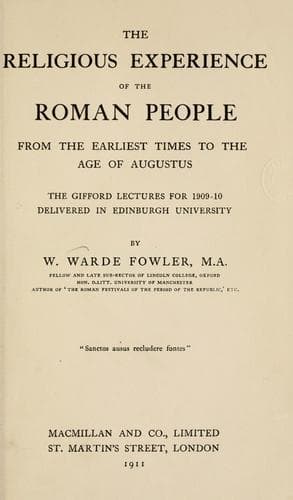
The Religious Experience of the Roman People: From the Earliest Times to the Age of AugustusFowler, W. Warde (William Warde)
Religion
The Religious Experience of the Roman People: From the Earliest Times to the Age of Augustus
Fowler, W. Warde (William Warde)
Cults -- Rome; Rome -- Religion
In pure animism the spirits are nameless; when their residence and
functions are more clearly recognised they acquire names, and these
names are naturally masculine or feminine among peoples whose language
is not genderless, as was the case with the Sumerians of
Babylonia.[298] This would seem to be the first step on the path to a
personal conception of divinity. But there are signs that the Romans had
not got very far on this path when we begin to know anything about their
religion. I have already alluded to the formula "Sive deus sive dea,"
which occurs in the ritual of the Fratres Arvales, in the formula given
by Cato for making a new clearing, and elsewhere;[299] and indeed there
seems to have been always some uncertainty about the sex of one or two
well-known deities, such as Pales and Pomonus or Pomona.[300] It is not,
therefore, _a priori_ probable that the process of personalisation (if I
may coin the word) should have proceeded, at the period we are treating
of, so far as to ascribe to these named deities of both sexes the
characteristics of human beings in social life and intercourse. Yet
Varro, as Dr. Frazer points out, is quoted by St. Augustine as saying
that his ancestors (that is, as Augustine adds), "veteres Romanos,"
believed in the marriage of gods and in their procreative power.[301] If
Varro wrote "maiores meos," as he seems to have done, of whom was he
really thinking? Was Augustine's comment based on the rest of Varro's
text, or was he jumping to a conclusion which would naturally serve his
own purpose? Varro, of course, was not a Roman, but from Reate in the
Sabine country. But even if he were thinking of Rome, how far back would
his knowledge extend? The Romans had known Greek married gods for three
or four centuries before his time, and he may quite well be thinking of
these. Of the _di indigetes_ of an earlier period he could hardly know
more than we do ourselves; his only sources of information were the
facts of the cult and the books of the pontifices. The facts of the
cult, so far as he and others have recorded them, suggest no pairing of
deities, no "sacred marriage."[302] The pontifical books, which
contained rules and formulae for the proper invocation of deities by
their right names, do indeed seem to have suggested a certain
conjunction of male and female divine names; and it is just possible
that this is what Varro had in his mind when he wrote the passage seized
upon by Augustine. I will proceed at once to examine this evidence, as
it is incidentally of great interest in the history of Italian religion;
and Dr. Frazer will probably allow that his conclusion must stand or
fall by it.
Public-domain text, read in full here on John Shaqi.
Reviews
Reviews
No reviews yet
Be the first to share your thoughts on this work.
Elsewhere in the archive
Join the Discussion
Join the discussion
Sign in to leave a comment or review.
Sign InorCreate an account