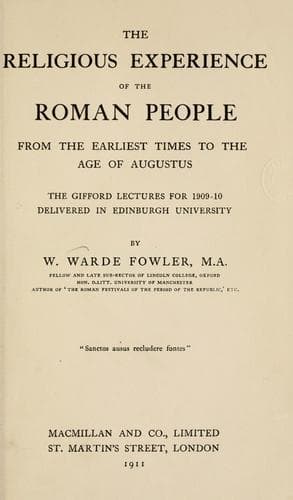
The Religious Experience of the Roman People: From the Earliest Times to the Age of AugustusFowler, W. Warde (William Warde)
Religion
The Religious Experience of the Roman People: From the Earliest Times to the Age of Augustus
Fowler, W. Warde (William Warde)
Cults -- Rome; Rome -- Religion
Dr. Frazer gives me an opportunity of adverting to another point bearing
on the question we are discussing,--the way in which the old Roman
thought of his deities. "It is difficult," he says,[316] "to deny that
the epithets Pater and Mater, which the Romans bestow on so many of
their gods, do really imply paternity and maternity; if this implication
be admitted, the inference appears to be inevitable that these divine
beings were supposed to exercise sexual functions, etc." In a footnote
he adds a number of formidable-looking references, meant, I suppose, to
prove this point. I have closely examined these passages; what they do
prove is simply that many deities were called Pater and Mater. Not one
even suggests that paternity and maternity were in such cases to be
understood literally and, so to speak, physically. The two that come
nearest to what he is looking for are those from Varro and Lactantius.
Varro says[317] that Ops was called Mater because she was identical with
Terra, who was, of course, Terra Mater: "Haec enim--
'terris gentes omnes peperit et resumit denuo,
quae dat cibaria,' ut ait Ennius."[318] It is clear, then, that neither
Varro nor Ennius understood this title of Ops and Terra in Dr. Frazer's
sense of the word. The quotation from the early Christian father
Lactantius, which contains three well-known lines of Lucilius, might
possibly deceive those who neglect to turn it out and read the context;
there we find at once that not even Lactantius could attribute to these
epithets the meaning which Dr. Frazer wishes to put on them. He would
have been as glad to do so as Dr. Frazer himself, though for a very
different reason; but what he actually wrote is this:--
"Omnem Deum qui ab homine colitur, necesse est inter solennes ritus et
precationes patrem nuncupari, non tantum honoris gratia, verum etiam
rationis; quod et antiquior est homine, et quod vitam, salutem, victum
praestat, ut pater. Itaque ut Iuppiter a precantibus pater vocatur,
etc."[319]
Dr. Frazer's quotation begins with this last sentence; it is a pity that
he did not read the context. If he had read it, his candour would have
compelled him to confess that not even a Christian father, with a keen
sense of what was ridiculous or degrading in the pagan religion,
understood the fatherhood of the gods as he wishes to understand it.
Public-domain text, read in full here on John Shaqi.
Reviews
Reviews
No reviews yet
Be the first to share your thoughts on this work.
Elsewhere in the archive
Join the Discussion
Join the discussion
Sign in to leave a comment or review.
Sign InorCreate an account