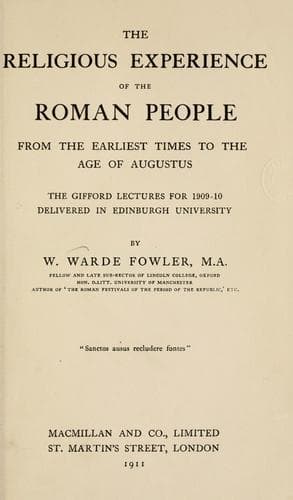
The Religious Experience of the Roman People: From the Earliest Times to the Age of AugustusFowler, W. Warde (William Warde)
Religion
The Religious Experience of the Roman People: From the Earliest Times to the Age of Augustus
Fowler, W. Warde (William Warde)
Cults -- Rome; Rome -- Religion
But I am wasting time in pressing this point. Dr. Frazer would hardly
have used such an argument if he had not been hard put to it. The
figurative use of human relationships is surely a common practice, when
addressing their deities, of all peoples who have reached the stage of
family life. As another distinguished anthropologist says: "The very
want of an object tends to supply an object through the imagination; and
this will be either the vital energy inherent in things, or the reflex
of the human father, who once satisfied his needs (_i.e._ of the
worshipper). So, in Aryan religions, the supreme god is father, [Greek:
Zeus pater], Diespiter, Marspiter. Ahura-Mazda is a father.... Another
analogy shows the relationship of brother and friend, as in the case of
Mithra."[320] The Romans themselves were familiar from the first with
such figurative use of relationship, as was natural to a people in whom
the family instinct was so strong; we have but to think of the _pater
patratus_ of the Fetiales,[321] of the Fratres Arvales, or the Fratres
Attiedii of Iguvium. What exactly they understood by Pater and Mater
when applied to deities is not so easy to determine: we have not the
necessary data. They were never applied, I believe, to imported deities,
_di novensiles_; always to _di indigetes_, those on whom the original
Roman stock looked as their fellow-citizens and guardians. And we shall
not be far wrong if we conclude that in general they imply the
dependence of the human citizen upon his divine protector, and thus
bring the usage into line with that of other Aryan peoples. Behind this
feeling of dependence there may have been the idea, handed down from
remote ages, that Father Sky and Mother Earth were in a sense the
parents of all living things; but there is nothing in the Roman religion
to suggest that the two were thought of as personally uniting in
marriage or a sexual act.
I will sum up this part of the discussion by translating an admirable
passage in Aust's book on the Roman religion, with which I am in cordial
agreement[322]:--
"The deities of Rome were deities of the cult only. They had no human
form; they had not the human heart with its virtues and vices. They had
no intercourse with each other, and no common or permanent residence;
they enjoyed no nectar and ambrosia ... they had no children, no
parental relation. They were indeed both male and female, and a male and
female deity are often in close relations with each other; but this is
not a relation of marriage, and rests only on a similarity in the sphere
of their operations.... These deities never become independent
existences; they remain cold, colourless conceptions, _numina_ as the
Romans called them, that is, supernatural beings whose existence only
betrays itself in the exercise of certain powers."
Public-domain text, read in full here on John Shaqi.
Reviews
Reviews
No reviews yet
Be the first to share your thoughts on this work.
Elsewhere in the archive
Join the Discussion
Join the discussion
Sign in to leave a comment or review.
Sign InorCreate an account