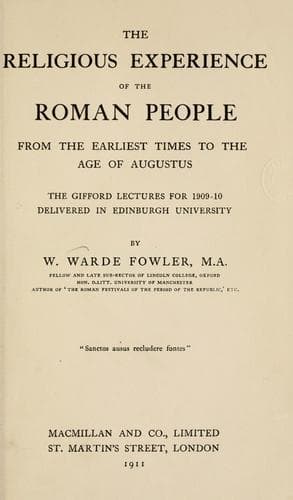
The Religious Experience of the Roman People: From the Earliest Times to the Age of Augustus — John Shaqi
The Religious Experience of the Roman People: From the Earliest Times to the Age of AugustusFowler, W. Warde (William Warde)
Religion
The Religious Experience of the Roman People: From the Earliest Times to the Age of Augustus
Fowler, W. Warde (William Warde)
Cults -- Rome; Rome -- Religion
"_Religion is the effective desire to be in right relations with the
Power manifesting itself in the universe._" This has the advantage of
treating religion as primarily and essentially a _feeling_, an
instinctive desire, and the word "effective," skilfully introduced,
suggests that this feeling manifests itself in certain actions
undertaken in order to secure a desired end. Again, the phrase "right
relations" seems to me well chosen, and better than the "living
relation" of M. Reville, which if applied to the religions of antiquity
can only be understood in a sacramental sense, and is not obviously so
intended. "Right relation" will cover all religious feeling, from the
most material to the most spiritual. Think for a moment of the 119th
Psalm, the high-water mark of the religious feeling of the most
religious people of antiquity; it is a magnificent declaration of
conformity to the will of God, _i.e._ of the desire to be in right
relation to Him, to His statutes, judgments, laws, commands,
testimonies, righteousness. This is religion in a high state of
development; but our definition is so skilfully worded as to adapt
itself readily to much earlier and simpler forms. The "Power manifesting
itself in the universe" may be taken as including all the workings of
nature, which even now we most imperfectly understand, and which
primitive man so little understood that he misinterpreted them in a
hundred different ways. The effective desire to be in right relation
with these mysterious powers, so that they might not interfere with his
material well-being--with his flocks and herds, with his crops, too, if
he were in the agricultural stage, with his dwelling and his land, or
with his city if he had got so far in social development--this is what
we may call the religious instinct, the origin of what the Romans called
_religio_.[8] The effective desire to have your own will brought into
conformity to the will of a heavenly Father is a later development of
the same feeling; to this the genuine Roman never attained, and the
Greek very imperfectly.
Public-domain text, read in full here on John Shaqi.
Reviews
Reviews
No reviews yet
Be the first to share your thoughts on this work.
Join the Discussion
Join the discussion
Sign in to leave a comment or review.
Sign InorCreate an account