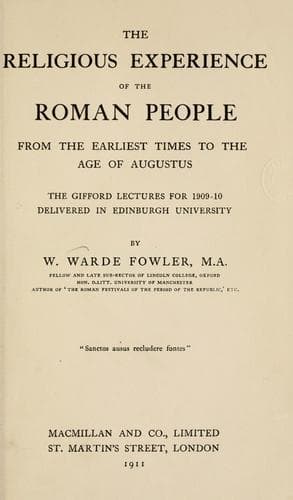
The Religious Experience of the Roman People: From the Earliest Times to the Age of AugustusFowler, W. Warde (William Warde)
Religion
The Religious Experience of the Roman People: From the Earliest Times to the Age of Augustus
Fowler, W. Warde (William Warde)
Cults -- Rome; Rome -- Religion
I have already frequently mentioned the _ius divinum_, the law governing
the relations between the divine and human inhabitants of the city, as
the _ius civile_ governed the relations between citizen and
citizen.[340] When we examined the calendar of Numa, we were in fact
examining a part of this law; we began with this our studies of the
religion of the Roman city-state, because it is the earliest document we
possess which illuminates the dark ages of city life, so far as religion
is concerned. The study of the calendar naturally led us on to consider
the evidence it yields, taken together with other sources of
information, as to the nature of the deities for whose worship it fixes
times and seasons, or, more accurately, the amount of knowledge to which
the Romans had attained about their divine beings. But we must now
return to the _ius divinum_, and study it in another aspect, for which
the calendar itself does not suffice as evidence.
Perhaps the simplest way of explaining this _ius_ is to describe it as
laying down the rules for the maintenance of right relations between the
citizens and their deities; as ordaining what things are to be done or
avoided in order to keep up a continual _pax_, or quasi-legal covenant,
between these two parties. The two words _ius_ and _pax_, we may note,
are continually meeting us in Roman religious documents. In a prayer
sanctioned by the pontifices for use at the making of a new clearing, we
read: "Si deus, si dea sit cuius illud sacrum est, _ut tibi ius siet_
porco piaculo facere illiusce sacri coercendi ergo,"[341] _i.e._ "O
unknown deity, whether god or goddess, whose property this wood is, let
it be legally proper to sacrifice to thee this pig as an expiatory
offering, for the sake of cutting down trees in this wood of thine."
"Pacem deorum exposcere" (or "petere") is a standing formula, as all
readers of Virgil know;[342] and it occurs in many other authors and
religious documents. When Livy wants to express the horror of the old
patrician families at the idea of plebeians being consuls--men who had
no knowledge of the _ius divinum_ and no right to have any--he makes
Appius Claudius exclaim, "Nunc nos, tanquam iam nihil pace deorum opus
sit, omnes caerimonias polluimus."[343] How can we maintain our right
relations with the gods, if plebeians have the care of them?
Public-domain text, read in full here on John Shaqi.
Reviews
Reviews
No reviews yet
Be the first to share your thoughts on this work.
Elsewhere in the archive
Join the Discussion
Join the discussion
Sign in to leave a comment or review.
Sign InorCreate an account