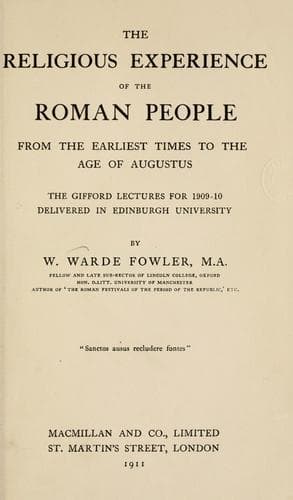
The Religious Experience of the Roman People: From the Earliest Times to the Age of AugustusFowler, W. Warde (William Warde)
Religion
The Religious Experience of the Roman People: From the Earliest Times to the Age of Augustus
Fowler, W. Warde (William Warde)
Cults -- Rome; Rome -- Religion
[324] Aug. _C.D._ vii. 17. That this was what Varro
meant by _di certi_ was first affirmed by Wissowa in a
note to his edition of Marquardt, p. 9; it has been
generally accepted as the true account. A full
discussion will be found in Agahd's edition of the
fragments of Varro's work, p. 126 foll.; cf. Peter's
article quoted above, and Wissowa, _R.K._ pp. 61 and 65.
A somewhat different view is given in Domaszewski's
article in _Archiv_ for 1907, p. 1 foll., suggested by
Usener's _Goetternamen_.
[325] The evidence for this will be found in Marquardt's
note 4 on p. 9. I have no doubt that Wissowa is right in
explaining Indigitamenta as "Gebetsformeln," formulae of
invocation; in which the most important matter, we may
add, would be the name of the deity. See his _Gesammelte
Abhandlungen_, p. 177 foll. The Indigitamenta contained,
as one section, the invocations of _di certi_.
[326] Chiefly by Ambrosch in his _Religionsbuecher der
Roemer_. Peter's article contains a useful account of the
whole progress of research on this subject.
[327] _Lex._ p. 137; it was that of his master
Reifferscheid. Cp. Wissowa, _op. cit._ (_Ges. Abhandl._
p. 306 foll.).
[328] _R.F._ pp. 191, 341.
[329] "The place of the Sondergoetter in Greek
Polytheism," printed in _Anthropological Essays
addressed to E. B. Tylor_, p. 81. Usener's discussion of
the Roman and Lithuanian Sondergoetter is in his
_Goetternamen_, p. 73 foll.
[330] Wissowa writes (_Ges. Abhandl._ p. 320 note) that
he has reason to believe that a great number of the
Lithuanian Sondergoetter only became such through the
treatment of the subject by the mediaeval writers on
whom Usener relied!
[331] _Ges. Abhandl._ p. 304 foll.
[332] Servius (Interpol.) _ad Georg._ i. 21.
[333] Henzen, _Acta Fratr. Arv._ p. 147; _C.I.L._ vi.
2099 and 2107.
[334] _Op. cit._ p. 323 foll.; for _famuli_ and _anculi
divi_, Henzen, _op. cit._ p. 145.
[335] See above, p. 121.
[336] p. 312; cp. 320, where he further asserts his
belief that Varro is responsible himself for the
creation of a great number of these Sondergoetter, owing
to his extreme desire to fix and define the function of
every deity in relation to human life; just as the
mediaeval writers Laskowski and Pretorius may have
created many Lithuanian Sondergoetter. As I am not quite
clear on this point, I have not mentioned it in the
text.
[337] _Op. cit._ p. 314, note 1. See above, note 33.
[338] _e.g._ Vaticanus, "qui infantum vagitibus
praesidet"; _Rusina_ from _rus_; _Consus_ from
_consilium_, etc.
[339] See above, p. 84.
LECTURE VIII
RITUAL OF THE _IUS DIVINUM_
Public-domain text, read in full here on John Shaqi.
Reviews
Reviews
No reviews yet
Be the first to share your thoughts on this work.
Elsewhere in the archive
Join the Discussion
Join the discussion
Sign in to leave a comment or review.
Sign InorCreate an account