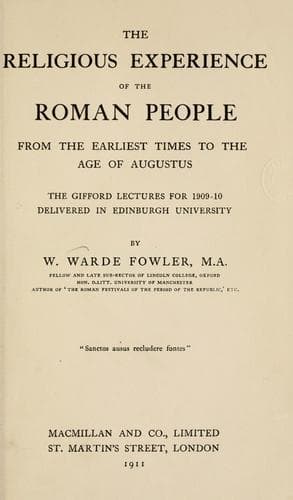
The Religious Experience of the Roman People: From the Earliest Times to the Age of AugustusFowler, W. Warde (William Warde)
Religion
The Religious Experience of the Roman People: From the Earliest Times to the Age of Augustus
Fowler, W. Warde (William Warde)
Cults -- Rome; Rome -- Religion
We have various forms of prayer surviving in Roman literature: some of
them are versified by the poets, and therefore give us a general
impression of the contents without the actual and genuine wording; we
have also two fragments of ancient _carmina_ which have the form of
prayers, those of the Salii and the Fratres Arvales; and we have certain
forms used on special occasions, such as the _evocatio_ of the gods of a
hostile community, or the formulae of vows (_vota_) which I must
postpone to the next lecture. But the only unquestionably genuine old
Roman prayers used at sacrifice, taken from the books of the pontifices
and preserved word for word, are those which Cato embodied in his
treatise on agriculture in the second century B.C., as proper to be used
with sacrifice on certain occasions in the agricultural year.[380] It is
here that we meet with the phrase, familiar in another form to all Latin
scholars, on which I wish to lay stress now. It occurs in all the four
forms of prayer which Cato copied down. The first is at the time of the
flowering of the pear-trees, on behalf of the oxen: "Iuppiter dapalis,
quod tibi fieri oportet in domo familia mea culignam vini dapi eius
rei[381] ergo, _macte hac illace dape polucenda esto_." And again, when
the wine is offered: "Iuppiter dapalis, _macte istace dape polucenda
esto. Macte vino inferio esto_." So in the piacular sacrifice when a
clearing is made, the unknown deity is addressed in the last words of
the prayer thus: "harum rerum ergo _macte hoc porco piaculo immolando
esto_." We find this _macte esto_ again in the prayer for the ceremony
of lustratio, at the end of the formula: "_macte hisce suovetaurilibus
lactentibus immolandis esto_." In the rite of the _porca praecidanea_,
to which I have already referred, the instruction for the invocation of
Jupiter runs: "_Fertum_ (_i.e._ a kind of cake) _Iovi obmoveto et
mactato sic, Iuppiter, te hoc ferto_ obmovendo bonas preces precor, uti
sies volens propitius mihi liberisque meis domo familiaeque meae _mactus
hoc ferto_." Janus gets another kind of cake (_strues_) and a
wine-offering, and is addressed in the same way. Then we read, "Iovi
fertum obmoveto _mactatoque item_, ut prius feceris."
Public-domain text, read in full here on John Shaqi.
Reviews
Reviews
No reviews yet
Be the first to share your thoughts on this work.
Elsewhere in the archive
Join the Discussion
Join the discussion
Sign in to leave a comment or review.
Sign InorCreate an account