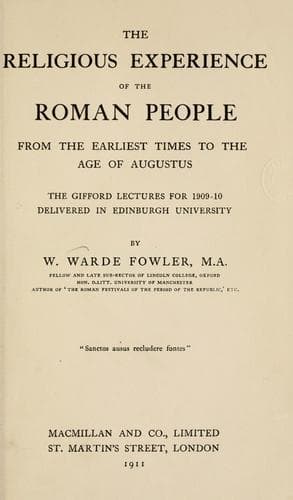
The Religious Experience of the Roman People: From the Earliest Times to the Age of AugustusFowler, W. Warde (William Warde)
Religion
The Religious Experience of the Roman People: From the Earliest Times to the Age of Augustus
Fowler, W. Warde (William Warde)
Cults -- Rome; Rome -- Religion
What is the real meaning of this phrase _macte esto_, which must surely
have been in universal use at sacrifices, not only at private rites like
those of Cato, since it came to be used in common speech of
congratulation or felicitation, e.g. _macte virtute esto_?[382] Servius
in commenting on Virgil has made it sufficiently clear. He explains it
as _magis aucte_, and connects it with _magmentum_, increase-offering,
_quasi magis augmentum_, and adds that when the victims had been slain
and their exta placed on the altar, they were said to be _mactatae_. So,
too, in another comment he seems to connect the word with the victim
rather than with the deity. But he is quite clear as to the meaning of
the word, as signifying an increase or addition of some kind; and though
his etymology is wrong, we may be sure that he was right in this
respect, for it is beyond doubt built on a base, _mac_ or _mag_, which
produced _magnus_, _maius_, _maiestas_, and so on. "Macte nova virtute
puer" means "Be thou increased, strengthened in _virtus_"; a fragment of
Lucilius (quoted by Servius) brings this out well, "_Macte inquam
virtute simulque his viribus esto_," and another from Ennius, "Livius
inde redit magno _mactatus_ triumpho."[383] We might almost translate it
in these passages by "glorified"; but it most certainly includes the
meaning of "strengthened" or "increased in might."
Now in the formulae of Cato we have seen that it is applied to the
deity and not to the victim; this naturally did not occur to Servius,
whose mind was occupied rather with Virgil and the literary use of the
word than with the original use and meaning of the language of prayer.
Undoubtedly he has made a mistake here, which Cato's piety has enabled
us to detect. It was, in fact, the deity whose strength was to be
increased by the offerings; so much at least seems to me to be beyond
doubt. There is, indeed, no certain trace in the ritual, or in Roman
literature, that the gods were supposed to consume the exta, or the
cakes and wine offered them; that primitive notion must have been
excluded from the _ius divinum_. But instead of it we find the more
spiritual idea that by placing on the altar the organs of the life of
the victim, with ancient forms of sacred cake and offerings of wine, the
vitality of the deity, his power to help his worshippers, to make the
corn grow and the cattle bring forth young, to aid the State against
enemies, or what not, was really increased in this semi-mystic way. Let
us remember that the Roman numina were powers constantly at work in
their own sphere; they are the various manifestations of the one Power
as conceived in immediate relation to man and his wants; they are
sometimes addressed in prayer, as we have seen, by additional titles
which suggest their strength and vitality: Virites Quirini, Nerio
Martis, Moles Martis, Maia or Maiestas Volcani. What, then, could be
more natural than that the Roman should call upon his divine
Public-domain text, read in full here on John Shaqi.
Reviews
Reviews
No reviews yet
Be the first to share your thoughts on this work.
Elsewhere in the archive
Join the Discussion
Join the discussion
Sign in to leave a comment or review.
Sign InorCreate an account