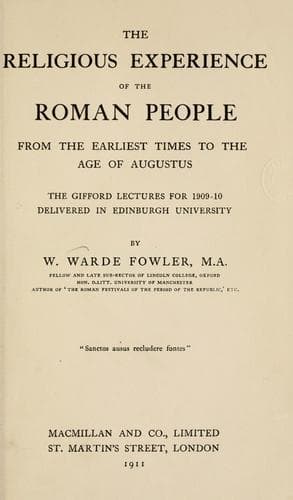
The Religious Experience of the Roman People: From the Earliest Times to the Age of AugustusFowler, W. Warde (William Warde)
Religion
The Religious Experience of the Roman People: From the Earliest Times to the Age of Augustus
Fowler, W. Warde (William Warde)
Cults -- Rome; Rome -- Religion
fellow-citizen to accept that which, according to ancient tradition and
practice, will keep up his strength, and at the same time increase his
glory and his goodwill towards his worshippers? This is, then, the idea
which I believe to have been at the root of Roman sacrificial ritual,
and it seems to confirm the dynamic theory of sacrifice recently
propounded by some French anthropologists, _i.e._ that a mystic current
of _religious force_ passed through the victim, from priest to deity,
and perhaps back again.[384] I believe that we have here a transitional
idea of the virtue of sacrifice--an idea that bridges over the gulf
between the crude notion that the gods actually partake of the offering,
and the later more spiritual view that the offering is an honorary gift
"to the glory of God." It seems also to be found in the Vedic religion.
Dr. Farnell writes: "In the Vedic ritual we find a pure and spiritual
form of prayer; yet a certain spell-power may attach even to the highest
types, for we find not infrequently the conception that not only the
power of the worshipper, but the power of the deity also is nourished
and strengthened by prayer, and the prayer itself is usually accompanied
by a potent act (such as that of sacrifice). "May our prayers increase
Agni": "The prayers fill thee with power and strengthen thee, like great
rivers the Sindhu."[385]
I must now turn to the form and manner of Roman prayers, in order to
gain further light on the question as to the mental attitude of the
worshipper towards the deity invoked. Of late years there has been a
strong tendency to find the origin of prayer in spell; or, in other
words, to discover a bridge between that mental attitude which believes
that a deity can be forced into a certain course of action by magical
formulae, and the humble attitude of the petitioner in prayer, which
assumes that the power of the deity altogether transcends that of his
worshipper. The evidence of Roman prayers is, I think, of considerable
value in dealing with this question; but it needs to be carefully
studied and handled. The general impression conveyed by those who have
written on the subject is that Roman prayers were dull, dry formulae,
which were believed to have a constraining influence on the deity simply
as formulae, if they were repeated with perfect precision the right
number of times. Dr. Westermarck, for example, has no shadow of a doubt
about this; quoting Renan, he says that "in the Roman, as in the
majority of the old Italian cults, prayer is a magic formula, producing
its effect by its own inherent quality." And again, he writes that the
Romans were much more addicted to magic than to religion; "they wanted
to compel the gods rather than to be compelled by them. Their _religio_
was probably near akin to the Greek [Greek: katadesmos], which meant not
only an ordinary tie, but also a magic tie or knot or a bewitching
thereby."[386] I need not stop to point out the misconception of the
Public-domain text, read in full here on John Shaqi.
Reviews
Reviews
No reviews yet
Be the first to share your thoughts on this work.
Elsewhere in the archive
Join the Discussion
Join the discussion
Sign in to leave a comment or review.
Sign InorCreate an account