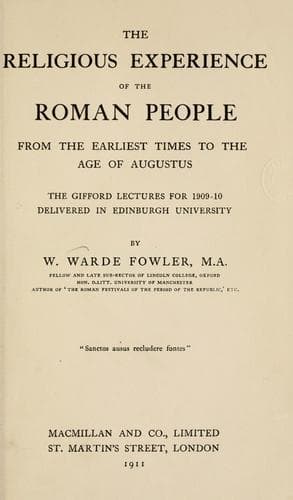
The Religious Experience of the Roman People: From the Earliest Times to the Age of AugustusFowler, W. Warde (William Warde)
Religion
The Religious Experience of the Roman People: From the Earliest Times to the Age of Augustus
Fowler, W. Warde (William Warde)
Cults -- Rome; Rome -- Religion
That in this prayer, and the others which accompany it, exactness of
wording was believed to be essential, as in the ritual which preceded it
exactness of performance, there is no doubt; for at the end of the whole
document (vi. B. 48) we find that if there had been any slip in the
ritual, the Brethren had to go back to the first gate and begin all over
again. There is plainly present the idea, surviving from an age of
magic, that the deities had strong feelings about the right way of
invocation, and would not respond to the performance unless those
feelings were understood and appealed to; that they would miss something
and decline to do their part. Yet are we justified in going on to assume
that they were bound, as by a solemn contract, to perform their part, if
there were no slip in the ritual? I confess it is difficult for me to
take this further step, in view of the language of the prayers, which is
so clearly that of petition, nay, of humble petition. We are not dealing
here with _vota_, to which I shall come in the next lecture, and in
which there is a kind of legal contract between the man and the god--the
former undertaking to do something pleasing to the deity, if the latter
shall have faithfully performed what is asked of him. These _vota_, so
abundant in historical times, are really responsible for the idea that
Roman prayer is simply a binding formula--a magical spell, let us say,
which in the hands of a city priesthood has become a quasi-legal
formula. But these prayers are not _vota_; they do not contain any
language which betrays the notion of binding the deity. They seem to me
to mark a process of transition between the age of spell and magic and
the age of prayer and religion; they retain some of the outward
characteristics of spell, but internally, _i.e._ in the spirit in which
they were intended, they have the real characteristics of prayer.[394]
The numina to whom they were addressed were powerful spirits, unknown,
unfamiliar, until their wishes were discovered by the organised
priesthood which handed down these forms of petition.
Public-domain text, read in full here on John Shaqi.
Reviews
Reviews
No reviews yet
Be the first to share your thoughts on this work.
Elsewhere in the archive
Join the Discussion
Join the discussion
Sign in to leave a comment or review.
Sign InorCreate an account