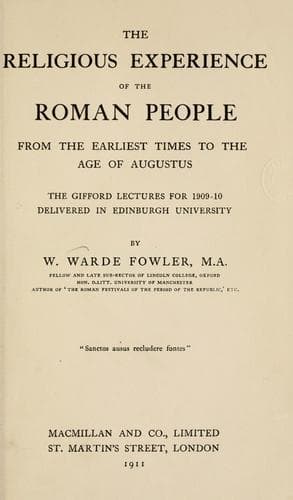
The Religious Experience of the Roman People: From the Earliest Times to the Age of AugustusFowler, W. Warde (William Warde)
Religion
The Religious Experience of the Roman People: From the Earliest Times to the Age of Augustus
Fowler, W. Warde (William Warde)
Cults -- Rome; Rome -- Religion
To return to Rome, and to the prayers in Cato's book, to which I
referred just now when discussing the word _macte_. Attempts have been
made to prove that these were originally written in metre;[395] and this
is quite possible. If so, it only means that they retained the outward
form of the primitive spell; it must not lead us on to fancy that the
sacrifice which accompanied the prayer was a magical act, or that the
whole process was believed to compel the deity. No doubt there was
believed to be efficacy in the exact repetition, as is shown by the
directions for piacular sacrifices in case of error of any kind.[396]
But the language is the language of prayer, not of compulsion, nor even
of bargaining: "Eius rei ergo te hoc porco piaculo immolando bonas
preces precor, ut sies volens propitius mihi, domo familiaeque
meis."[397] "Mars pater, te precor quaesoque uti sies volens propitius
mihi, domo," etc.[398] No amount of vain repetition or scruple can
deprive this language of its natural meaning. The god is powerful in his
own sphere of action, and man has no control over him; man is fully
recognised as liable to misfortune unless the god helps him; but he can
worship in full assurance of faith that his prayer will be answered, if
it be such as the authorities of the State have laid down as the right
wording, and if the ritual accompanying it is equally in order. The
faith is, indeed, thus founded upon man's devices rather than the god's
good-will as such; it is a belief in the State and its authorities and
_ius divinum_, which is conceived, not indeed as constraining the deity,
but as calling upon him (_invocare_) to perform his part, in formulae
which he cannot well neglect, simply because it would be unreasonable
to do so, contrary to his nature as a deity of the Roman State and its
_ager_.
Public-domain text, read in full here on John Shaqi.
Reviews
Reviews
No reviews yet
Be the first to share your thoughts on this work.
Elsewhere in the archive
Join the Discussion
Join the discussion
Sign in to leave a comment or review.
Sign InorCreate an account