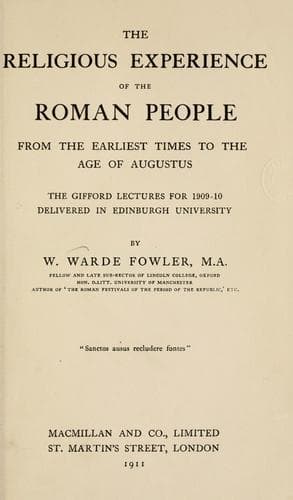
The Religious Experience of the Roman People: From the Earliest Times to the Age of AugustusFowler, W. Warde (William Warde)
Religion
The Religious Experience of the Roman People: From the Earliest Times to the Age of Augustus
Fowler, W. Warde (William Warde)
Cults -- Rome; Rome -- Religion
It is obvious in all this sacrificial ritual that the officiating person
or persons were expected to observe the traditional forms with the
utmost care and exactness. Any slip or omission was, in fact, a
_piaculum_, or _sacrum commissum_--terms of the _ius divinum_ which seem
to suggest, if I may use the expression, the obverse side of holiness.
It is now well known that cleanness and uncleanness, holiness and its
opposite, can be expressed in religious vocabulary by the same terms,
for in both cases there is something beyond the ordinary, something
dangerous, uncanny; thus we are not surprised to find that such words as
I have just mentioned can be used to express some kind of impurity
caused by a breach of ritual as well as that ritual itself. If we accept
the latest theory of sacrifice, _i.e._ the dynamic theory, as it is
called, we explain this intense nervousness about a ritualistic flaw as
occasioned by the consciousness of a breach in the current of "religious
force" (the expression is that of Messrs. Hubert and Mauss[399]), which
must pass in regular sequence from the sacrificer through the victim to
the deity, or vice versa. If this is the true explanation--and at
present it may be said to hold the field--then the extreme exactness of
the Roman ritual was a survival from an age when this strange feeling
was a reality; but no more than a survival, for, so far as I can
discover, the Roman idea was rather that the deity to whom the ritual
was addressed was in some way offended by the omission.[400] The dynamic
notion is lost, if it ever were there, and its place has been taken by
one that we may perhaps call theological. But however that may be, the
culprit was regarded as in a state of sin or impurity, "un etre sacre,"
and had to get rid of this sin or impurity by another sacrifice before
the whole ritual could be started afresh (_instaurare_).
According to the "dynamic" theory of sacrifice, we might naturally
expect that the victim, as being destined to carry away the unholiness
(or whatever we choose to call it) of the culprit, would be burnt whole,
not offered to the deity in the form of exta, or eaten by the
sacrificers.[401] But this does not seem to have been the case in the
Roman practice; in all the examples of _piacula_ of which we have
details, the exta are laid on the altar as in the typical
sacrifice.[402] The inference seems to be that the theological idea of
sacrifice had established itself completely ever since the formation of
the _ius divinum_; the victim is not a scapegoat in any sense, but
really an expiatory offering; and not only does the sacrificer yield up
something of value, but he offers it to increase the strength of the
deity as well as to appease his anger.
Public-domain text, read in full here on John Shaqi.
Reviews
Reviews
No reviews yet
Be the first to share your thoughts on this work.
Elsewhere in the archive
Join the Discussion
Join the discussion
Sign in to leave a comment or review.
Sign InorCreate an account