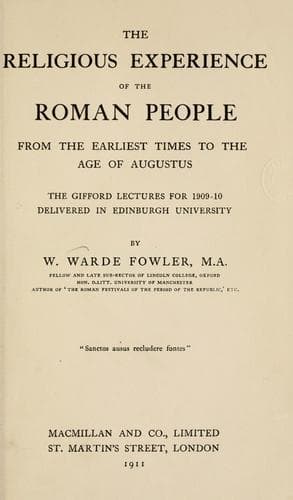
The Religious Experience of the Roman People: From the Earliest Times to the Age of AugustusFowler, W. Warde (William Warde)
Religion
The Religious Experience of the Roman People: From the Earliest Times to the Age of Augustus
Fowler, W. Warde (William Warde)
Cults -- Rome; Rome -- Religion
I am more immediately concerned with the desire expressed in our
definition _when it has become more effective_; and this we find in the
Latins when they have attained to a complete settlement on the land, and
are well on in the agricultural stage of social development. This stage
we can dimly see reflected in the life of the home and farm of later
times; we have, I need hardly say, no contemporary evidence of it,
though archaeology may yet yield us something. But the conservatism of
rural life is a familiar fact, and comes home to me when I reflect that
in my own English village the main features of work and worship remained
the same through many centuries, until we were revolutionised by the
enclosure of the parish and the coming of the railroad in the middle of
the nineteenth century. The intense conservatism of rural Italy, up to
the present day, has always been an acknowledged fact, and admits of
easy explanation. We may be sure that the Latin farmer, before the
City-state was developed, was like his descendants of historical times,
the religious head of a family, whose household deities were
_effectively_ worshipped by a regular and orderly procedure, whose dead
were cared for in like manner, and whose land and stock were protected
from malignant spirits by a boundary made sacred by yearly rites of
sacrifice and prayer. Doubtless these wild spirits beyond his boundaries
were a constant source of anxiety to him; doubtless charms and spells
and other survivals from the earlier stage were in use to keep them from
mischief; but these tend to become exceptions in an orderly life of
agricultural routine which we may call _religious_. Spirits may accept
domicile within the limits of the farm, and tend, as always in this
agricultural stage, to become fixed to the soil and to take more
definite shape as in some sense deities. This stage--that of the
agricultural family--is the foundation of Roman civilised life, in
religious as in all other aspects, and it will form the subject of my
fourth lecture.
Public-domain text, read in full here on John Shaqi.
Reviews
Reviews
No reviews yet
Be the first to share your thoughts on this work.
Join the Discussion
Join the discussion
Sign in to leave a comment or review.
Sign InorCreate an account