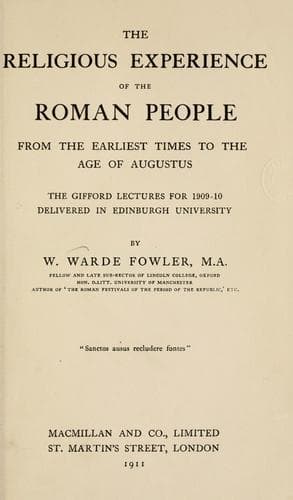
The Religious Experience of the Roman People: From the Earliest Times to the Age of AugustusFowler, W. Warde (William Warde)
Religion
The Religious Experience of the Roman People: From the Earliest Times to the Age of Augustus
Fowler, W. Warde (William Warde)
Cults -- Rome; Rome -- Religion
[394] Wissowa, _R.K._, 333, inclines to the belief that
prayer had a legal binding force upon the deity; but he
does not cite any text which confirms this view, and is
arguing on general grounds. I gather from the language
of Aust (_Religion der Roemer_, p. 30) that he thinks
there was a germ which might have developed into a more
truly religious attitude towards the gods, if it had not
been killed by priestly routine and quasi-legal
formulae. With this opinion I am strongly inclined to
agree. Cp. the story of Scipio Aemilianus audaciously
altering and elevating the formula dictated by the
priest in the censor's lustratio (Val. Max. iv. 1. 10),
to which I shall return in the proper place.
[395] Westphal, quoted by De Marchi, _La Religione,
etc._, i. p. 133, note.
[396] See, _e.g._, ch. 141 _ad fin._ The prayer in the
Acta of the Ludi Saeculares to the Moirae is an
imitation of old prayers. See below, p. 442.
[397] _ib._ ch. 139.
[398] _ib._ ch. 141.
[399] Hubert et Mauss, _Melanges d'histoire des
religions_, p. 74.
[400] So Cato, _R.R._ 141, "si minus in omnes litabit,
sic verba concipito; Mars pater, quod tibi illuc porco
neque satisfactum est, te hoc porco piaculo." (The word
for the slaughter is here euphemistically omitted; De
Marchi, p. 134.)
[401] Hubert et Mauss, _op. cit._ p. 55 foll.; Leviticus
vi. I doubt whether the theory of the learned authors
will hold good generally on this point.
[402] Marquardt, p. 185, asserted the contrary, but
cited no evidence except Serv. _Aen._ vi. 253, which
does not prove the practice of the holocaust to be
really Roman. Wissowa's exactness is well illustrated in
his detection of this error; see _R. K._ p. 352, note 6.
Henzen, _Acta Fratr. Arv._ p. 135, leaves no doubt on
the question possible.
[403] Henzen, _Acta Fratr. Arv._ p. 131. See above, p.
35. Festus, p. 218.
[404] Gellius iv. 6. 7.
[405] _i.e._ lustratio. That this was a form of piaculum
is clear from the use of the word _pihaklu_ of the
victim in the lustratio of the arx of Iguvium, _e.g._
Buecheler, _Umbrica_, index, 5, v.
LECTURE IX
RITUAL--_continued_
Public-domain text, read in full here on John Shaqi.
Reviews
Reviews
No reviews yet
Be the first to share your thoughts on this work.
Elsewhere in the archive
Join the Discussion
Join the discussion
Sign in to leave a comment or review.
Sign InorCreate an account