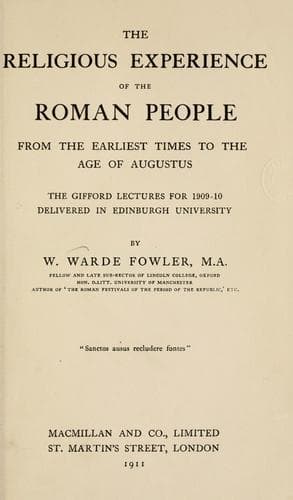
The Religious Experience of the Roman People: From the Earliest Times to the Age of AugustusFowler, W. Warde (William Warde)
Religion
The Religious Experience of the Roman People: From the Earliest Times to the Age of Augustus
Fowler, W. Warde (William Warde)
Cults -- Rome; Rome -- Religion
In the last lecture we found that the magical element in the Roman
ritual is exaggerated by recent writers. But it has also long been the
practice to describe that ritual as a system of bargaining with the
gods: as partaking of the nature of a legal contract. "The old Roman
worship was businesslike and utilitarian. The gods were partners in a
contract with their worshippers, and the ritual was characterised by the
hard formalism of the legal system of Rome. The worshipper performed his
part to the letter with the scrupulous exactness required in pleadings
before the praetor."[406] This is an excellent statement of a view very
generally held, especially since Mommsen, whose training in Roman law
made him apt to dwell on the legal aspects of Roman life, wrote the
famous chapter in the first volume of his history. I now wish to examine
this view briefly.
No doubt it was suggested by the necessary familiarity of the Roman
historian with _vota publica_, the vows so frequently made on behalf of
the State by its magistrates, in terms supplied by the pontifices, and
dictated by them to the magistrate undertaking the duty. Some few of
these formulae have survived, and it may certainly be said of them that
they are analogous to legal formulae, and express the quasi-contractual
nature of the process. Such legalised religious contracts seem to be
peculiar to Rome; they are curiously characteristic of the Roman genius
for formularisation, which in course of time had most important effects
in the domain of civil law. But the vow as such is, of course, by no
means peculiar to Rome; it is familiar in Greek history, and is found in
an elementary form among savages at the present day.[407] But at Rome
both in public and private life it is far more frequent and striking
than elsewhere. This is a phenomenon that calls for careful study; and
we must beware that we are not misled by quasi-legal developments into
missing the real significance of it from the point of view of morality
and religion.
Public-domain text, read in full here on John Shaqi.
Reviews
Reviews
No reviews yet
Be the first to share your thoughts on this work.
Elsewhere in the archive
Join the Discussion
Join the discussion
Sign in to leave a comment or review.
Sign InorCreate an account