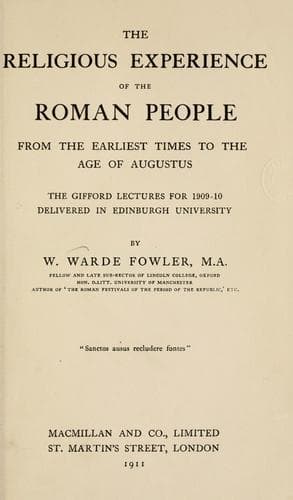
The Religious Experience of the Roman People: From the Earliest Times to the Age of AugustusFowler, W. Warde (William Warde)
Religion
The Religious Experience of the Roman People: From the Earliest Times to the Age of Augustus
Fowler, W. Warde (William Warde)
Cults -- Rome; Rome -- Religion
The _vota privata_, which include vows and offerings made to deities by
private individuals, had never been adequately examined till De Marchi
wrote his book on the private religion of the Romans; nor could they
have been so examined until the _Corpus Inscriptionum_ was fairly well
advanced. There the material is extraordinarily abundant, but it is, of
course, almost entirely of comparatively late date, and the great
majority of votive inscriptions belong to the period of the Empire. Yet
it is quite legitimate to argue from this to an origin of this form of
worship in the earliest times, and we have enough early evidence to
justify the inference. Among the oldest Latin inscriptions are some
found on objects such as cups or vases, showing that the latter were
votive offerings to a deity: thus we have _Saeturni poculum, Kerri
poculum_, and other similar ones which will be found at the beginning of
the first volume of the _Corpus_.[408] They give only the name of the
deity as a rule, and do not tell us why the object was offered to him;
but they must have been thank-offerings for some supposed blessing. In
one case, not indeed at Rome, but not far away at Praeneste, we have
proof of this; for a mother makes a dedication to Fortuna _nationu
cratia_, which plainly expresses gratitude for good luck in
childbirth;[409] and this inscription is one of the oldest we possess.
Nor do they tell us whether there was a previous vow or promise of which
the offering is the fulfilment. But in the majority of inscriptions of
late date the familiar letters V.S.L.M. (_votum solvit lubens merito_)
betray the nature of the transaction, and it is not unreasonable to
guess that there was usually a previous undertaking of some kind, to be
carried out if the deity were gracious.
Public-domain text, read in full here on John Shaqi.
Reviews
Reviews
No reviews yet
Be the first to share your thoughts on this work.
Elsewhere in the archive
Join the Discussion
Join the discussion
Sign in to leave a comment or review.
Sign InorCreate an account