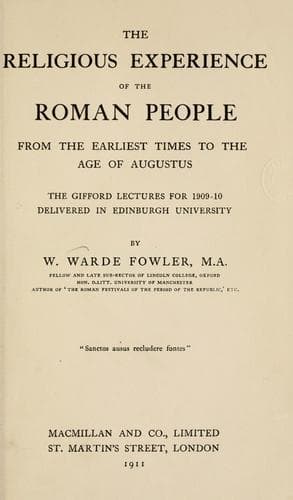
The Religious Experience of the Roman People: From the Earliest Times to the Age of AugustusFowler, W. Warde (William Warde)
Religion
The Religious Experience of the Roman People: From the Earliest Times to the Age of Augustus
Fowler, W. Warde (William Warde)
Cults -- Rome; Rome -- Religion
The public _vota_ were of two kinds: the ordinary, or regularly
recurring, and the extraordinary, which were occasioned by some
particular event. Of the ordinary, the most familiar is that undertaken
by the consul, and no doubt in some form by the Rex in the days of the
kingship, for the benefit of the State on the first day of the official
year. Accompanied by the Senate and a crowd of people, the consuls went
up to the Capitoline temple, and performed the sacrifice which had been
vowed by their predecessors of a year before; after which they undertook
a new _votum_, "_pro reipublicae salute_."[412] We have not the formula
of this vow, and cannot tell what resemblance it bore to a bargain; but
the ceremony itself must have been most impressive, and calculated to
remind all who were present of the greatness and goodwill of the supreme
deity who watched over the interests of the State. So too at the
_lustrum_ of the censors, which took place in the Campus Martius every
five years, it is almost certain that the _votum_ of the predecessors in
office was fulfilled by a sacrifice, and a new one undertaken. Here
again we are without the formula, but that there was one we know from a
very interesting passage of Valerius Maximus. He tells us that Scipio
Aemilianus, when as censor he was conducting this sacrifice, and the
_scriba_ (on behalf of the pontifex?) was dictating to him the _solemne
precationis carmen ex publicis tabulis_, in which the immortal gods were
besought to make the prosperity of the Roman State "better and
greater," had the audacity to interrupt him, saying that the condition
of the State was sufficiently good and great: "itaque precor ut eas
(res) perpetuo incolumes servent." This change, Valerius says, was
accepted, and the formula altered accordingly in the _tabulae_.[413]
This story, which is probably genuine and is quite characteristic of
Scipio, must convince an impartial mind that in this votive ceremony
there was enough truth and dignity to suggest a real advance in
religious thought, so far at least as the State was concerned.
Public-domain text, read in full here on John Shaqi.
Reviews
Reviews
No reviews yet
Be the first to share your thoughts on this work.
Elsewhere in the archive
Join the Discussion
Join the discussion
Sign in to leave a comment or review.
Sign InorCreate an account