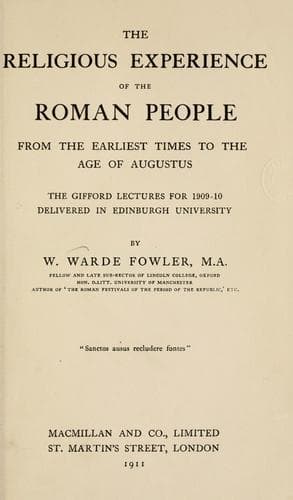
The Religious Experience of the Roman People: From the Earliest Times to the Age of AugustusFowler, W. Warde (William Warde)
Religion
The Religious Experience of the Roman People: From the Earliest Times to the Age of Augustus
Fowler, W. Warde (William Warde)
Cults -- Rome; Rome -- Religion
The extraordinary _vota_ were innumerable. They were occasioned by
dangers or misfortunes of various kinds, the magistrate undertaking to
dedicate something to the god concerned if the State should have come
safely through the peril. Many temples had their origin in this
practice;[414] we meet also with _ludi_, special sacrifices, or a tithe
of the booty taken in war. In two or three cases Livy has copied the
formula from the _tabulae_ of the pontifices; thus before the war with
Antiochus in 191 B.C., the consul recited the following words after the
pontifex maximus: "Si duellum quod cum Antiocho rege sumi populus
iussit, id ex sententia senatus populique Romani confectum erit; tum
tibi Iuppiter populus Romanus ludos magnos dies decem continuos faciet
... quisquis magistratus eos ludos quando ubique faxit, hi ludi recte
facti, donaque data recte sunto."[415] This document dates from the days
of the decay of the Roman religion, and is, of course, modernised by
Livy; but it may give an idea of what is meant by writers who speak of
an element of bargain or covenant in these _vota_. Still more elaborate,
and probably more antique, is the famous formula of the vow of the _ver
sacrum_ in the darkest hour of the war with Hannibal.[416] This very
curious rite, which proves beyond question the devotion of the Italian
stocks to the principle of the _votum_, consisted of a promise to
dedicate to Mars or Jupiter all the valuable products of a single
spring, including the male children born at that time; to this the
Romans had recourse for the last time in 217 B.C., and Livy has
fortunately preserved the words of the vow. These, with the exception of
the dedication of the children, which is judiciously omitted, probably
stand much as they had come down from a remote antiquity. The _votum_ is
put in the form of a _rogatio_ to the people, without whose sanction it
could not be put in force; are they willing to dedicate to Jupiter all
the young of oxen, sheep, or pigs born in the spring five years after
date, if the State shall have been preserved during those years from all
its enemies? The curious feature of the document is, not that it binds
the deity to any course of action, but that it secures the individual
Roman against his anger in case of any chance slip in his part of the
process, and the people against any evil consequences arising from such
a slip or from misdoing on the part of an individual. "Si quis clepsit,
ne populo scelus esto neve cui cleptum erit: si atro die faxit insciens,
probe factum esto."[417] Of this formula a recent writer of great
learning and ability has written thus: "The well-known liturgical
archive containing Rome's address to Jupiter in the critical days of the
Hannibalic war is a wary and cleverly drawn legal document, intended to
bind the god as well as the State."[418] He is no exception to the rule
that those who have not habitually occupied themselves with the Roman
religion are liable to misinterpret its details.
Public-domain text, read in full here on John Shaqi.
Reviews
Reviews
No reviews yet
Be the first to share your thoughts on this work.
Elsewhere in the archive
Join the Discussion
Join the discussion
Sign in to leave a comment or review.
Sign InorCreate an account