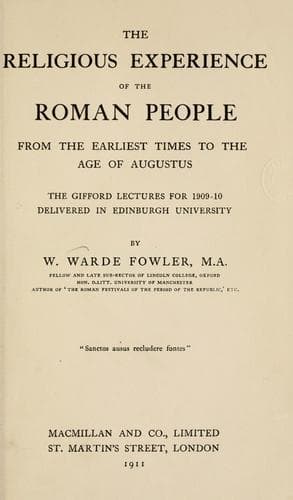
The Religious Experience of the Roman People: From the Earliest Times to the Age of AugustusFowler, W. Warde (William Warde)
Religion
The Religious Experience of the Roman People: From the Earliest Times to the Age of Augustus
Fowler, W. Warde (William Warde)
Cults -- Rome; Rome -- Religion
This is not an address
to Jupiter, nor is there any sign in it that the god was considered as
bound to perform his part as in a contract; the covenant is a one-sided
one, the people undertaking an act of self-renunciation if the god be
gracious to them, and thereby going far to assure themselves that he
will so be gracious. And the legal cast of the language, which seems so
apt to mislead the unwary,[419] is only to be found in the clauses which
guarantee the people against the contingency of the whole vow being
ruined by the inadvertence or the rascality of an individual; surely a
very natural and inevitable _caveat_, where for once the whole people,
and not only their priests or magistrates, were concerned in the
transaction.
A curious form of the _votum_, which, however, I can only mention in
passing, is that addressed to the gods of a hostile city, with a view to
induce them to desert their temples and take up their abode at Rome;
this is the process called _evocatio_, which was successfully applied at
the siege of Veii, when Juno Regina consented to betray her city.[420]
Macrobius, commenting on Virgil's lines (_Aen._ ii. 351),
excessere omnes adytis arisque relictis
di quibus imperium hoc steterat,
has preserved the _carmen_ used at the siege of Carthage.[421] It is
cast in the language of prayer: "Si deus si dea est cui populus
civitasque Carthaginiensis est in tutela ... precor venerorque veniamque
a vobis peto ut vos populum civitatemque Carthaginiensem deseratis,"
etc.; but it ends with a vow to build temples and establish _ludi_ in
honour of these deities if they should comply with the petition. It is
worth noting here that it was, of course, impossible to make a bargain
with strange or hostile gods, or in any way to force their hand; the
promise is entirely one-sided; and I am inclined to think that in
dealing with his own gods the mental attitude of the Roman was much the
same, though his faith in them was undoubtedly greater.
This is the proper place to mention another very curious rite, closely
allied to the _votum_, but differing from it in one or two important
points, which is almost peculiar to the Romans and most characteristic
of them; I mean the _devotio_ of himself on the field of battle by a
magistrate _cum imperio_.[422] The famous example, familiar to us all,
is that of Decius Mus at the battle of Vesuvius in the great Latin
war[423] (340 B.C.): the same story is told of his son in a war with
Gauls and Samnites, and of his grandson in the war with Pyrrhus.[424]
The historical difficulties of these accounts do not concern us now; by
common consent of scholars the method and formula of the _devotio_ are
authentic, and the rite must have had its origin in remote antiquity.
Public-domain text, read in full here on John Shaqi.
Reviews
Reviews
No reviews yet
Be the first to share your thoughts on this work.
Elsewhere in the archive
Join the Discussion
Join the discussion
Sign in to leave a comment or review.
Sign InorCreate an account