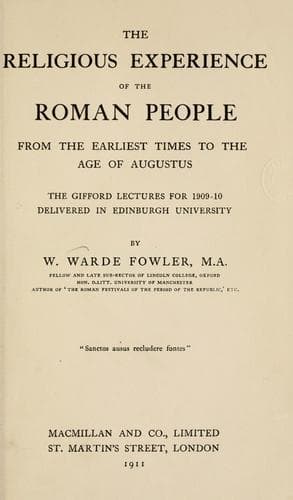
The Religious Experience of the Roman People: From the Earliest Times to the Age of AugustusFowler, W. Warde (William Warde)
Religion
The Religious Experience of the Roman People: From the Earliest Times to the Age of Augustus
Fowler, W. Warde (William Warde)
Cults -- Rome; Rome -- Religion
As it was necessary to protect the homestead and its land by a sacred
boundary, so the city had to be clearly marked off from all that was
outside of it. Its walls were sacred, or, strictly speaking, a certain
imaginary line outside of them called the _pomoerium_ was sacred. This
is well shown in the traditional method of founding a city even in
historical times, _e.g._ a _colonia_, as described by Varro, Servius,
and Plutarch.[450] A white ox and a white cow were harnessed to a
plough, of which the share must be made of bronze--a rule which shows at
once the antiquity and the religious character of the rite, for iron, as
we saw, was taboo in most religious ceremonies. A rectangular furrow was
drawn where the walls of the city were to be; the earth was turned
inwards to mark the future line of the wall, and the furrow represented
the future _pomoerium_. When the plough came to the place where there
was to be a gate, it was lifted over it, and the ploughing resumed
beyond it. This probably meant, as Plutarch expressed it, that the walls
(or rather the _pomoerium_), were sacred while the gates were profane;
had the gates been holy, scruple would necessarily have been felt about
the passage in and out of them of things profane. Thus the _pomoerium_
was a boundary line between the sacred and the profane, like that of the
farm; but in historical times it acquired a more definite religious
meaning, for within it there could only dwell those deities who belonged
to the city and its inhabitants, _i.e._ the _di indigetes_, and who were
recognised as its divine inhabitants.[451] And only within its limits
could the _auspicia_ of the city be taken.
Public-domain text, read in full here on John Shaqi.
Reviews
Reviews
No reviews yet
Be the first to share your thoughts on this work.
Elsewhere in the archive
Join the Discussion
Join the discussion
Sign in to leave a comment or review.
Sign InorCreate an account