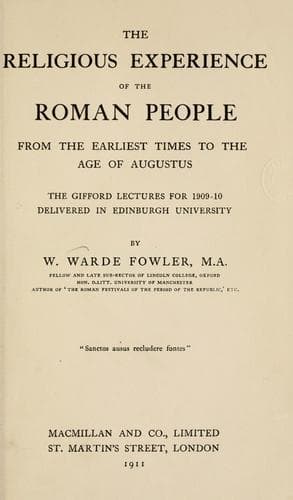
The Religious Experience of the Roman People: From the Earliest Times to the Age of AugustusFowler, W. Warde (William Warde)
Religion
The Religious Experience of the Roman People: From the Earliest Times to the Age of Augustus
Fowler, W. Warde (William Warde)
Cults -- Rome; Rome -- Religion
We should naturally expect that this sacred boundary would have its
holiness secured or revived by an annual _lustratio_ like that of the
farm and _pagus_; and so no doubt it was. But the memory of this
survives only in the word _amburbium_, which, on the analogy of
_ambarvalia_, must mean a rite of this processional kind. Luckily we
have definite knowledge of the real _lustratio_ of a city in those
ritualistic inscriptions of Iguvium which I have more than once referred
to.[452] It is the _lustratio_ of the _arx_, the citadel of Iguvium,
which we may guess to have been the original _oppidum_ or germ of the
historical city. The details are complex, and show clear traces of
priestly organisation; but the main features stand out unmistakably. A
procession goes round the _arx_ (_ocris Fisia_), with the
_suovetaurilia_--ox, sheep, and pig--as in the Latin _lustratio_; at
each gate it stops, while sacrifice and prayer are offered on behalf of
the citadel, the city, and the whole people of Iguvium. There were three
gates, and each of them is the scene of sacrifice and prayer, because
they are the weak points in the wall, and they need to be strengthened
by annual religious operations; such at least is the most obvious
explanation. Whether the Fratres Attiedii would have been able to
explain it thus we may doubt; neither in the sacrificial ritual nor in
the prayers, as recorded in the inscription, do we find any clear trace
of a distinction between the sacred and the profane, or of the idea of a
hostile spiritual world outside the sacred boundary. So far as we can
judge from the prayers, the object is really a religious one, to implore
the deities of the city to preserve it and all within it. The language
of these prayers hardly differs from that in which a Christian Church of
to-day asks for a blessing on a community.[453]
Public-domain text, read in full here on John Shaqi.
Reviews
Reviews
No reviews yet
Be the first to share your thoughts on this work.
Elsewhere in the archive
Join the Discussion
Join the discussion
Sign in to leave a comment or review.
Sign InorCreate an account