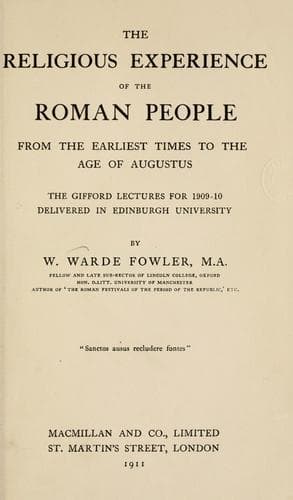
The Religious Experience of the Roman People: From the Earliest Times to the Age of AugustusFowler, W. Warde (William Warde)
Religion
The Religious Experience of the Roman People: From the Earliest Times to the Age of Augustus
Fowler, W. Warde (William Warde)
Cults -- Rome; Rome -- Religion
[428] By Deubner in _Archiv_, 1905, p. 69 foll. This
touching of the chin seems to be an example of that
personal contact which makes a man or thing holy; see,
_e.g._, Westermarck, _op. cit._ i. 586. Decius makes
himself holy for the sacrifice (as victim) by touching
(as priest) the only part of his person which was
exposed. For the magic touch of the hand see O.
Weinrich, _Antike Heiligungswuender_, p. 63 foll., and
Macrobius iii. 2. 7, for the touching of the altar by a
sacrificing priest.
[429] See above, p. 180.
[430] This is Deubner's explanation, which he elaborates
at length by examples of the worship of the spear or
sword among various peoples.
[431] This is peculiar to the formula in Livy viii. 9.
Is it possible that it may have some reference to the
fact that the Romans were fighting their own kin, the
Latins?
[432] Buecheler, _Umbrica_, pp. 22 and 102: "hastatos
inhastatos completo timore tremore, fuga formidine, nive
nimbo, fragore furore, senio servitio," where, however,
the translator from the Umbrian is assisted by the Latin
formulae we are discussing.
[433] Macrobius iii. 9. 10, "exercitum quem ego me
sentio dicere fuga formidine terrore compleatis," etc.
This is of comparatively late origin, as it is addressed
to Dis pater, who only became a Roman deity in 249 B.C.
(Wissowa, _R.K._ p. 257). The interesting feature in
this _devotio_, used at the siege at Carthage, is that
it is not himself whom the commander devotes--the common
sense of the Romans had got beyond that--but the enemy
as substitutes for himself. "Eos vicarios pro me fide
magistratuque meo pro populo Romano exercitibus do
devoveo, ut me meamque fidem imperiumque legiones
exercitumque nostrum bene salvos siritis esse." Thus the
enemy is made the victim, and this is why the only gods
invoked are the Di Inferi, Dis pater, Veiovis, Manes,
while in the older formula it is the gods of Romans and
Latins. Pacuvius in a praetextata called _Decius_ wrote:
"Lue patrium hostili fusum sanguen sanguine" (Ribbeck,
p. 280). This is the language Ennius used before him of
the sacrifice of Iphigenia: "ut hostium eliciatur
sanguis sanguine," where, however, the word _eliciatur_
shows that it is magic. The curious thing in this last
passage is that the parallel passage in the Euripidean
_Iph. in Aul._ (1486) does not suggest magic. Is the
idea Italian? The curse (for such it really is) is to be
witnessed by Tellus and Iuppiter, and the celebrant
points down and up respectively in invoking them, as
also in the _devotio_ of Curtis in the Forum (Livy vii.
6), which was an abnormal _procuratio prodigii_.
Public-domain text, read in full here on John Shaqi.
Reviews
Reviews
No reviews yet
Be the first to share your thoughts on this work.
Elsewhere in the archive
Join the Discussion
Join the discussion
Sign in to leave a comment or review.
Sign InorCreate an account