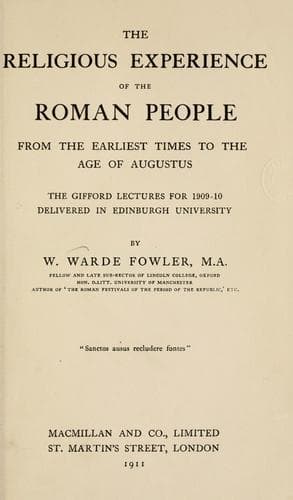
The Religious Experience of the Roman People: From the Earliest Times to the Age of AugustusFowler, W. Warde (William Warde)
Religion
The Religious Experience of the Roman People: From the Earliest Times to the Age of Augustus
Fowler, W. Warde (William Warde)
Cults -- Rome; Rome -- Religion
[434] Cp. the language used by Livy of the second Decius
(x. 29): "prae se agere formidinem ac fugam ...
contacturum funebribus diris signa tela arma hostium."
For spells or curses of this kind see Westermarck i.
563: a curse is conveyable by speech, especially if
spoken by a magistrate or priest. "Among the Maoris the
anathema of the priest is regarded as a thunderbolt that
an enemy cannot escape." See also Robertson Smith,
_Semites_, p. 434, for the Jewish ban, by which impious
sinners, or enemies of the city and its God, were
devoted to destruction. He remarks that the Hebrew verb
to ban is sometimes rendered "consecrate": Micah iv. 13;
Deut. xiii. 16; and Joshua vi. 26 (Jericho), which
exactly answers to the consecratio of Carthage. For
curses conveyable by sacrifices, as in all the cases I
have mentioned, see Westermarck ii. 618 foll. 624, and
the same author's paper on conditional curses in
Morocco, in _Anthropological Essays_, addressed to E. B.
Tylor, p. 360.
[435] "Abate their pride, assuage their malice, and
confound their devices." I well remember hearing this
read in church throughout the Crimean war.
[436] "Pro republica Quiritium," in the formula quoted
above.
[437] Livy viii. 10 _ad fin._
[438] See above, note 28.
[439] See Marquardt, p. 276 and notes; Mommsen,
_Strafrecht_, 900 foll. The subject has generally been
treated from the legal point of view rather than the
religious; but from the religious point of view it has
generally been assumed that the sacrifice was to appease
the god. So no doubt it was; but I venture also to
conjecture that the victim was _vicarius_ for the
contamination of the community. On the subject generally
Westermarck's two chapters on human sacrifice and
blood-revenge (xix. and xx. in vol. i.) are extremely
well worth reading.
[440] _Aen._ i. 607 foll. Cp. _Aen._ iii. 429--
praestat Trinacrii metas lustrare Pachyni
cessantem, longos et circumflectere cursus,
where the slow movement and circuitous course of a
lustratio must have been in Virgil's mind. The movement
round an object for lustral purposes is seen in _Aen._
vi. 229, "idem ter socios pura circumtulit unda," where
Servius explains _circumtulit_ by _purgavit_. As early
as Livius Andronicus (second century B.C.) we find
"classem lustratur" of fishes swimming round a fleet
(Ribb. _Trag. Fragmenta_, p. 1).
Public-domain text, read in full here on John Shaqi.
Reviews
Reviews
No reviews yet
Be the first to share your thoughts on this work.
Elsewhere in the archive
Join the Discussion
Join the discussion
Sign in to leave a comment or review.
Sign InorCreate an account