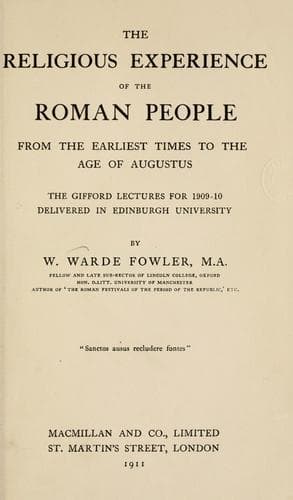
The Religious Experience of the Roman People: From the Earliest Times to the Age of AugustusFowler, W. Warde (William Warde)
Religion
The Religious Experience of the Roman People: From the Earliest Times to the Age of Augustus
Fowler, W. Warde (William Warde)
Cults -- Rome; Rome -- Religion
I said in my first lecture that the whole story of Roman religious
experience falls into two parts: first, that of the formularisation of
rules and methods for getting effectively into right relations with the
Power manifesting itself in the universe; secondly, that of the gradual
discovery of the inadequacy of these, and of the engrafting on the State
religion of Rome of an ever-increasing number of foreign rites and
deities. The first of these stories has been occupying us so far, and
before I leave it for what will be practically an introduction to
succeeding lectures, it will be as well for me to sum up the results at
which we have already arrived.
I began with what I called the protoplasm of religion, the primitive
ideas and practices which form the psychological basis of the whole
growth. The feeling of awe and anxiety about that which is mysterious
and unknown, the feeling which the Romans called _religio_, seems to
have manifested itself in Italy, as elsewhere, in those various ways
which I discussed in my second and third lectures, in the various forms
of magic, negative and positive. We find unmistakable evidence of the
existence of those strict rules of conduct called taboos, which fetter
the mind and body of primitive man, which probably arise from an
ineffective desire to put himself in right relations with forces he does
not understand, and which have their value as a social discipline.
Again, we find surviving in historical Rome numerous forms of active or
positive magic, by which it was thought possible to compel or overcome
those powers, so as to use them for your own benefit and against your
enemies. But I was careful to point out that on the whole little of all
this evidence of the early existence of magic at Rome is to be found in
the public religion of the Roman State, and that the natural inference
from this is that at one time or another there must have been a very
powerful influence at work in cutting away these obsolete root-leaves of
the plant that was to be, and in making of that plant a neat,
well-defined growth.
Public-domain text, read in full here on John Shaqi.
Reviews
Reviews
No reviews yet
Be the first to share your thoughts on this work.
Elsewhere in the archive
Join the Discussion
Join the discussion
Sign in to leave a comment or review.
Sign InorCreate an account