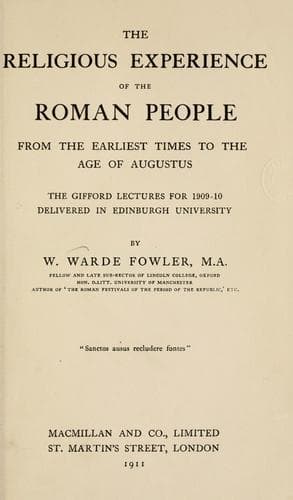
The Religious Experience of the Roman People: From the Earliest Times to the Age of AugustusFowler, W. Warde (William Warde)
Religion
The Religious Experience of the Roman People: From the Earliest Times to the Age of Augustus
Fowler, W. Warde (William Warde)
Cults -- Rome; Rome -- Religion
In no other ancient State that we know of did the citizen so entirely
resign the regulation of all his dealings with the State's gods to the
constituted authorities set over him. His obligatory part in the
religious ritual of the State was simply _nil_, and all his religious
duty on days of religious importance was to abstain from civil business,
to make no disturbance. Within the household he used his own simple
ritual, the morning prayer, the libation to the household deities at
meals; and it is exactly here that we see a _pietas_, a sense of duty
consecrated by religion, which seems to have had a real ethical value,
and reminds us of modern piety. But in all his relations with the gods
_qua_ citizen, he resigned himself to the trained and trusted
priesthoods, who knew the secrets of ritual and all that was comprised
in the _ius divinum_; and by passive obedience to these authorities he
gradually began to deaden the sense of _religio_ that was in him. And
this tendency was increased by the mere fact of life in a city, which as
time went on became more and more the rule; for, as I pointed out, the
round of religious festivals no longer exactly expressed the needs and
the work of that agricultural life in which it had its origin.
It would be an interesting inquiry, if the material for an answer were
available, to try and discover how this gradual absorption of religion
(or rather religious duties) by the State and its authorities affected
the morality of the individual Roman. It has often been maintained of
late that religion and morality have nothing in common; and even Dr.
Westermarck,[464] who, unlike most anthropologists, treats the whole
subject from a psychological point of view, seems inclined to come to
this conclusion. For myself, I am rather disposed to agree with another
eminent anthropologist,[465] that religion and morality are really
elemental instincts of human nature, primarily undistinguishable from
each other; and if that be so, then the over-elaboration of either the
moral or religious law, or of the two combined, will tend to weaken the
binding force of both. If, as at Rome, the citizen is made perfectly
comfortable in his relations with the Power manifesting itself in the
universe, owing to the complete mastery of the _ius divinum_ by the
State and its officials, there will assuredly be a tendency to paralyse
the elemental religious impulse, and with it, if I am not mistaken, the
elemental sense of right and wrong. For in the life of a state with such
a legalised religious system as this, so long at least as it thrives and
escapes serious disaster, there will be few or none of those moments of
peril and anxiety in which "man is brought face to face with the eternal
realities of existence,"[466] and when he becomes awakened to a new
sense of religion and duty. In the life of the family, the critical
moments of birth, puberty, marriage, and death regularly recur, and keep
Public-domain text, read in full here on John Shaqi.
Reviews
Reviews
No reviews yet
Be the first to share your thoughts on this work.
Elsewhere in the archive
Join the Discussion
Join the discussion
Sign in to leave a comment or review.
Sign InorCreate an account