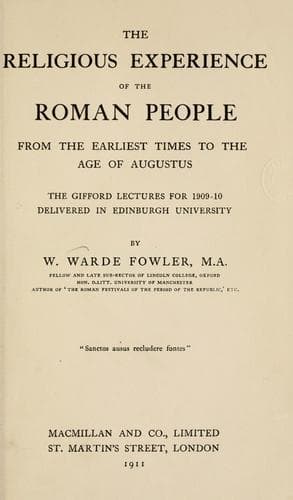
The Religious Experience of the Roman People: From the Earliest Times to the Age of AugustusFowler, W. Warde (William Warde)
Religion
The Religious Experience of the Roman People: From the Earliest Times to the Age of Augustus
Fowler, W. Warde (William Warde)
Cults -- Rome; Rome -- Religion
up the instinct, because man is then brought face to face with these
eternal facts; there is no need of extraordinary perils, such as
tempests or pestilences, to keep the instinct alive. But in the life of
the State as such there were no such continually recurring reminders;
even the old agricultural perils were out of sight of the ordinary
citizen. Thus the farthest we can go in ascribing a moral influence to
the State religion is in giving it credit for helping to maintain that
sense of law and order which served to keep the life of the family sound
and wholesome. That it did to some extent perform this service I have
already pointed out;[467] and it is a remarkable fact that the decay of
the State religion was coincident, in the last two centuries B.C., with
the decay of the family life and virtues. But on the whole, as we shall
see, the _ius divinum_ had rather the effect of hypnotising the
religious and moral instinct than of keeping it awake. It needed new
perils for the State as a whole to re-create that feeling which is the
root of the growth of conscience; and when the craving did at last come
upon the Roman, which in times of doubt and peril has come upon
individuals and communities in all ages, for support and comfort from
the Unseen, it had to be satisfied by giving him new gods to worship in
new ways--aliens with whom he had nothing in common, who had no home in
his patriotic feeling, no place in his religious experience.[468]
I wish to conclude this first part of my subject by giving some account
of the first beginning of this introduction of new deities, _di
novensiles_ as they were called,[469] into the old Roman religious
world. Those, however, of whom I shall speak here were not introduced as
the result of disaster or distress, but were simply the inevitable
consequence of the growing importance of the city on the Tiber--of the
beginnings of her commercial and political relations with her
neighbours, and also of her own development in the arts of civilisation.
The religious system with which I have so far been dealing was the
exclusive property, we must remember, of those _gentes_, with the
families composing them, which formed the original human material of the
State, and were known as _patrician_. If we had no other reason for
being sure of this, the fact that all State priesthoods were originally
limited to patrician families would be sufficient to prove it;[470] even
down to the latest times the _rex sacrorum_, the three _flamines
maiores_, and the _Salii_ were necessarily of patrician birth--a fact
which had much to do with their tendency to disappear in the last age of
the Republic.
Public-domain text, read in full here on John Shaqi.
Reviews
Reviews
No reviews yet
Be the first to share your thoughts on this work.
Elsewhere in the archive
Join the Discussion
Join the discussion
Sign in to leave a comment or review.
Sign InorCreate an account