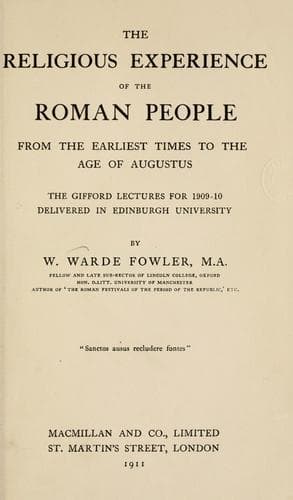
The Religious Experience of the Roman People: From the Earliest Times to the Age of AugustusFowler, W. Warde (William Warde)
Religion
The Religious Experience of the Roman People: From the Earliest Times to the Age of Augustus
Fowler, W. Warde (William Warde)
Cults -- Rome; Rome -- Religion
But in the course of the period within which the Numan calendar was
drawn up, this community of patrician burghers began to suffer certain
changes. A population of "outsiders," as in so many Greek cities, had
gained admittance to the site of Rome, though not into its political and
religious organism.[471] So solid a city, in such an important position,
was sure to attract such settlers, whether from the Latins dwelling
about it, or from the Etruscans on the north, or the Greek cities along
the coast southwards and in Sicily. The Latins were, of course, of the
same stock as the Romans, and already in some loose political relation
to them; and as each Latin city was open, like Rome, to Greek and
Etruscan influences, we should probably see in Latium an indirect
channel of communication between those peoples and Rome, to be reckoned
in addition to the direct and obvious one. As Dr. J. B. Carter has well
said,[472] "the Latins, becoming rapidly inferior to Rome, were enabled
to do her at least this service, that of absorbing the foreign
influences which came, and in certain cases of Latinising them, and thus
transmitting them to Rome in a more or less assimilated condition." As
Dr. Carter has been the first to explain the arrival of these new
religious influences to English readers, I shall in what follows closely
follow his footsteps. They indicate and also reflect a change from
agricultural economy and habits to a society interested in trade and
travel: I say interested, because we cannot be quite sure how far the
old Romans engaged in such pursuits themselves, as well as admitting
from outside those who did, with their worships. They indicate also the
growth of an industrial population, organised in gilds, as in the Middle
Ages; here beyond doubt the workers were mainly of native birth. Lastly,
they indicate an advance in military efficiency and, as a result of this
military progress, some change in the relation of Rome to her
fellow-communities of Latium.
Public-domain text, read in full here on John Shaqi.
Reviews
Reviews
No reviews yet
Be the first to share your thoughts on this work.
Elsewhere in the archive
Join the Discussion
Join the discussion
Sign in to leave a comment or review.
Sign InorCreate an account