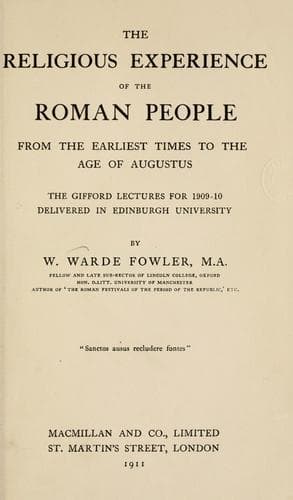
The Religious Experience of the Roman People: From the Earliest Times to the Age of AugustusFowler, W. Warde (William Warde)
Religion
The Religious Experience of the Roman People: From the Earliest Times to the Age of Augustus
Fowler, W. Warde (William Warde)
Cults -- Rome; Rome -- Religion
[483] Waltzing, _Etude historique sur les corporations
romaines_, vol. i. pp. 63 and 199. The relation between
town life and trades is stated with his usual insight by
von Jhering, _Evolution of the Aryan_, p. 93 foll.
[484] See Mueller-Deecke, _Etrusker_, ii. 47; Deecke,
_Falisker_, p. 89 foll.
[485] Minerva or Menrva is assuredly not Etruscan,
though frequently found on Etruscan monuments; see
Deecke, _l.c._ p. 89 foll.
[486] Fasti Praenestini in _C.I.L._ i.^2 March 19.
"Artificum dies (quod Minervae) aedis in Aventino eo die
est (dedicata)." This is one of those additional notes
in the Fast. Praen., which are believed to have been the
work of Verrius Flaccus: see _Roman Festivals_, p. 12.
[487] Wissowa, _Gesammelte Abhandlungen_, p. 288. We
know the fact from Strabo's account of Massilia, Bk. iv.
p. 180.
[488] Dion. Hal. iv. 26. See _R.F._ p. 198.
[489] Statius, _Silvae_ iii. 1. 60. See Wissowa's
article "Diana" in Pauly-Wissowa, _Real-Encycl._
[490] Wissowa, _l.c._ p. 332.
[491] _Golden Bough_, i. p. 1 foll.; _Early History of
the Kingship_, Lecture I.
[492] Varro, _L.L._ 5. 43; Carter, _op. cit._ p. 55.
[493] See on Fortuna the exhaustive article by R. Peter
in the _Mythological Lexicon_; Wissowa, _R.K._ 206
foll.; _R.F._ p. 161 foll., and 223 foll.; Carter, _op.
cit._ p. 50 foll. Dr. Carter seems to me to be too
certain of the absence of any idea of luck or chance in
the original conception of Fortuna: the word _fors_, so
far as we know, never had any other meaning, and the
deity Fors must be a personification of an abstraction,
like Ops, Fides, and Salus. See Axtell, _Deification of
abstract idea in Roman literature_, p. 9, with whom I
agree in rejecting the notion of Marquardt and Wissowa
that she was a deity of horticulture. He rightly points
out that she is not included in the list of agricultural
deities in Varro, _R.R._ i. 1. 6.
[494] See Aust in his article "Jupiter" in the _Myth.
Lex._ p. 689, where the evidence for the contemporaneous
origin of the temple on the Alban hill and that on the
Capitol is fully stated. In this case excavations have
confirmed the Roman tradition, which ascribed the former
temple to one or other of the Tarquinii. Jordan, _Roem.
Top._ i. pt. 2. p. 9.
Public-domain text, read in full here on John Shaqi.
Reviews
Reviews
No reviews yet
Be the first to share your thoughts on this work.
Elsewhere in the archive
Join the Discussion
Join the discussion
Sign in to leave a comment or review.
Sign InorCreate an account