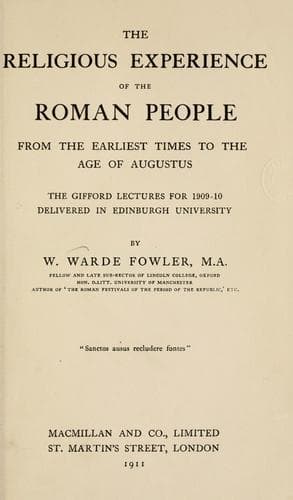
The Religious Experience of the Roman People: From the Earliest Times to the Age of AugustusFowler, W. Warde (William Warde)
Religion
The Religious Experience of the Roman People: From the Earliest Times to the Age of Augustus
Fowler, W. Warde (William Warde)
Cults -- Rome; Rome -- Religion
So, too, in all other questions which concerned the maintenance of the
family, and especially in regard to the devolution of property. I am
here only illustrating the way in which the pontifical college acquired
their paramount influence by having a quantity of new and difficult work
forced upon them, and it is not part of my plan to explain the early
history of adoptions and wills; but I may give a single concrete
illustration for the benefit of those who are not versed in Roman law.
It must constantly have happened, in that disturbed period which brought
the kingship to an end, that by death or capture in war a family was
left without male heirs. Daughters could not take their place, because
the _sacra_ of a family could not be maintained by daughters, who would,
in the natural order of things, be sooner or later married and so become
members of other families. Hence the expedient was adopted of making a
_filius familias_ of another family a member of your own; and this, like
marriage, involved a straining of the relations between the human and
divine members of your family, and was thus a matter for the religious
authorities to contrive in such a manner as to preserve the _pax_
between them. The difficulty was overcome by the practical wisdom of the
pontifical college, which held a solemn inquiry into the case before
submitting it to the people in specially summoned assembly (_comitia
calata_);[565] and thus the new _filius familias_ was enabled not only
to renounce his own _sacra_ (_detestatio sacrorum_), but to pass into
the guardianship of another set of _sacra_, without incurring the anger
of the _numina_ concerned with the welfare of either.
Public-domain text, read in full here on John Shaqi.
Reviews
Reviews
No reviews yet
Be the first to share your thoughts on this work.
Elsewhere in the archive
Join the Discussion
Join the discussion
Sign in to leave a comment or review.
Sign InorCreate an account