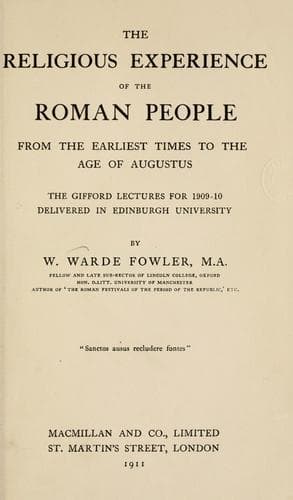
The Religious Experience of the Roman People: From the Earliest Times to the Age of AugustusFowler, W. Warde (William Warde)
Religion
The Religious Experience of the Roman People: From the Earliest Times to the Age of Augustus
Fowler, W. Warde (William Warde)
Cults -- Rome; Rome -- Religion
Such difficult matters as these, and many more connected directly or
indirectly with the devolution of property, such as the guardianship of
women and of the incapable, the power to dispose of property otherwise
than by the original rules of succession, the law of burial and the care
of the dead,--all these, at the time of which I am speaking, must have
been among the secrets of the pontifices; and we can also suspect,
though without being sure of our facts, that the great increase of the
importance of the _plebs_ under the Etruscan dynasty offered further
opportunities for the growth alike of the work and influence of the
college.[566] Above all, we must remember that this work was done in
secret, that the mysteries of adjustment were unknown to the people when
once they had passed out of the ken of family and gens, and that there
could have been no appeal from the pontifices to any other body. Nay,
more, we must also bear in mind that this body of religious experts was
_self-electing_. Until the lex Domitia of 104 B.C. both pontifices and
augurs filled up their own colleges with persons whom they believed
qualified both by knowledge and disposition. Thus it would seem that
there was every chance that in that early Rome, where neither in family
nor State could anything be undertaken without some reference to the
religious authority, where the _pax deorum_ was the one essential object
of public and private life, a power might be developed apt one day not
only to petrify religion and stultify its worshippers, but thereby also
to cramp the energies of the community, acting as an obstacle to its
development within its walls and without. Had Roman law remained
entirely in the hands of this self-electing college, one of two things
must have happened: either that college would have become purely secular
in character, or the wonderful legal system that we still enjoy would
never have had space to grow up. But this was not to be; with the
publication of the XII. Tables a new era opens.
Public-domain text, read in full here on John Shaqi.
Reviews
Reviews
No reviews yet
Be the first to share your thoughts on this work.
Elsewhere in the archive
Join the Discussion
Join the discussion
Sign in to leave a comment or review.
Sign InorCreate an account