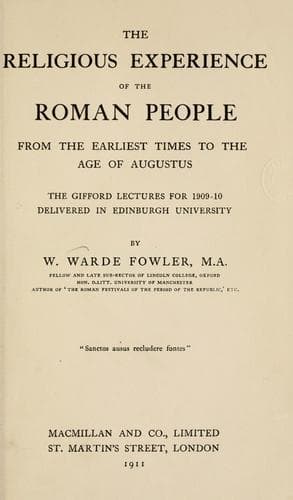
The Religious Experience of the Roman People: From the Earliest Times to the Age of AugustusFowler, W. Warde (William Warde)
Religion
The Religious Experience of the Roman People: From the Earliest Times to the Age of Augustus
Fowler, W. Warde (William Warde)
Cults -- Rome; Rome -- Religion
If we reject, as we conscientiously may, the latest attempts of
criticism to post-date the drawing up of the Tables,[567] and in fact to
destroy their historical value for us, what is their significance for
our present purpose? It is simply that in the middle of the fifth
century B.C. the pontifices lost a monopoly--ceased to be the sole
depositaries of the rules of law affecting the _pax deorum_, and that
new rules are being set down in writing, on the basis of old custom,
which more especially affect the relations between the human citizens.
For both the _ius divinum_ and the _ius civile_ are to be found in this
collection, but the latter is beginning to assert its independence. I
think we may say, without much hesitation, that this event, however
doubtful its traditional details, did actually save Rome from either of
the two consequences to which I alluded just now. The constitution
developed itself on lay and not on ecclesiastical lines, leaving the
pontifices other work to do, and Roman civil law was eventually able to
free itself from the trammels of the _ius divinum_.
But for another century the college still found abundant legal work to
do, for it was not likely that at Rome, the most conservative of all
city-states, it could be quickly set aside, or that the old ideas of law
could so speedily disappear. What then was this work?
When rules of civil law were written down, it was still necessary to
deal with them in two ways which were open to the pontifices, and indeed
at this early time to no one else. First, it was necessary to make their
provisions effectual by prescribing in each case the proper method of
procedure (_actio_). Now it is most important to grasp the fact that
procedure in the _ius civile_ was originally of precisely the same
nature as procedure in the _ius divinum_, and that precisely the same
rigid exactness is indispensable in both. Action and formula in civil
law belong to the same class of practices as sacrifice and prayer in
religious law, and spring from the same mental soil. Thus, for example,
the most familiar case of action and formula in civil law, the
_sacramentum_, was, as the name proves, a piece of religious procedure,
_i.e._ the deposition in a sacred spot of a sum of money which the
suitor in the case would forfeit if he lost it, together with the
utterance of a certain formula of words which must be correctly spoken.
If we choose to go back so far, we may even see in this combination of
formularised act and speech a survival of magical or quasi-magical
belief;[568] but this is matter rather for the anthropologist than the
historian of religion. The point for us at this moment is that these
acts and formulae (_legis actiones_, as they are known in Roman law)
could not suddenly or rapidly pass out of the hands of that body of
skilled experts which had so long been in sole possession of them; the
publication of old and new rules of law in the XII. Tables made no
immediate difference in this respect.
Public-domain text, read in full here on John Shaqi.
Reviews
Reviews
No reviews yet
Be the first to share your thoughts on this work.
Elsewhere in the archive
Join the Discussion
Join the discussion
Sign in to leave a comment or review.
Sign InorCreate an account