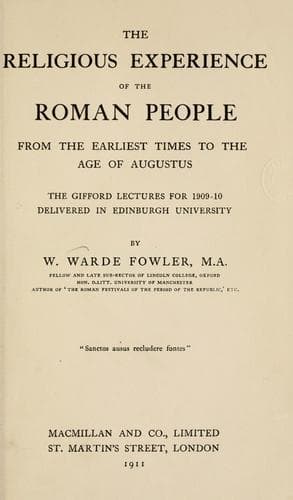
The Religious Experience of the Roman People: From the Earliest Times to the Age of AugustusFowler, W. Warde (William Warde)
Religion
The Religious Experience of the Roman People: From the Earliest Times to the Age of Augustus
Fowler, W. Warde (William Warde)
Cults -- Rome; Rome -- Religion
And indeed in one sense this was so. It must have been so, for as the
range of the State's activity increased, the sphere of religious
influence became relatively less. Marriage, for example, though it still
needed a religious ceremony in common opinion, ceased to need it in the
eye of the law--a change which is familiar to us in our own age. The
pontifex was no longer indispensable to the suitor at law, nor to the
citizen who wished to know on what day he might proceed with his suit.
The college undoubtedly ceased to be the powerful secretly-acting body
in whose hands was the entire _religio_ of the citizen, _i.e._ the
decision of all points on which he might feel the old anxious
nervousness about the good-will of the gods. But now we mark a change
which gave the old institution new life and new work. At the end of this
fourth century (300 B.C.) it was thrown open to plebeians by the lex
Ogulnia; and, as I have already mentioned, within a few years we come
upon a plebeian pontifex maximus, who was not even a Roman by birth, yet
one of the most famous in the whole series of the holders of that great
office. Most probably, too, the numbers of the members have already been
increased from five to nine, of whom five must be plebeian. These
members begin to be found holding also civil magistracies, and the
pontifex maximus was often a consul of the year. It is quite plain then
that this priestly office is becoming more and more secularised; it
expands with the new order of things instead of shrinking into itself.
It leaves religion, in the proper sense of the word, far behind. The
sacrificing priests, the flamines, etc., who were the humbler members in
a technical sense of the same college, go on with their proper and
strictly religious work under the supervision of the pontifex
maximus,[572] but they steadily become of less importance as the greater
members become secularised in their functions and their ambitions. And
these greater members, instead of becoming stranded on a barren shore of
antique religion, boldly venture into a new sphere of human life, and
add definite secular work to their old religious functions.
Public-domain text, read in full here on John Shaqi.
Reviews
Reviews
No reviews yet
Be the first to share your thoughts on this work.
Elsewhere in the archive
Join the Discussion
Join the discussion
Sign in to leave a comment or review.
Sign InorCreate an account