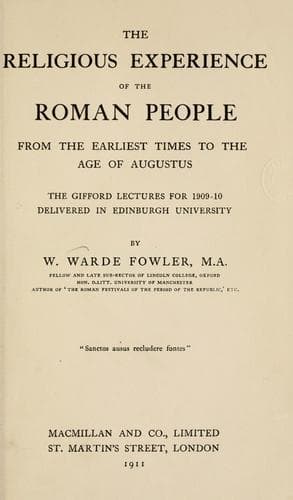
The Religious Experience of the Roman People: From the Earliest Times to the Age of AugustusFowler, W. Warde (William Warde)
Religion
The Religious Experience of the Roman People: From the Earliest Times to the Age of Augustus
Fowler, W. Warde (William Warde)
Cults -- Rome; Rome -- Religion
The events of the latter part of the fourth century B.C., culminating in
the publication of the Fasti and the _legis actiones_, probably meant
much more for the Romans than we can divine by the uncertain light of
historical imagination. It is the age of expansion, internal and
external; the old patrician exclusive rule was gone beyond recall; the
plebeians had forced their way into every department of government,
including at last even the great religious _collegia_; the old Latin
league had been broken up, and the Latin cities organised in various new
relations to Rome, each one being connected with the suzerain city by a
separate treaty, sealed with religious sanctions. After the Samnite wars
and the struggle with Pyrrhus, further organisation was necessary, and
there arose by degrees a loose system of union which we are accustomed
to call the Italian confederation. The adaptation of all these new
conditions to the existing order of things at Rome was the work of the
senate and magistrates so far as it concerned human beings only; but so
far as it affected the relations of the divine inhabitants of the
various communities it must have been the work of the pontifices. That
work is indeed almost entirely hidden from us, for Livy's books of this
period are lost, and Livy is the only historian who has preserved for us
in any substance the religious side of Rome's public life. But what we
have learnt in the course of these lectures will have made it plain that
no political changes could take place without involving religious
adaptation, and also that the only body qualified to undertake such
adaptation was the pontifical college.
Public-domain text, read in full here on John Shaqi.
Reviews
Reviews
No reviews yet
Be the first to share your thoughts on this work.
Elsewhere in the archive
Join the Discussion
Join the discussion
Sign in to leave a comment or review.
Sign InorCreate an account