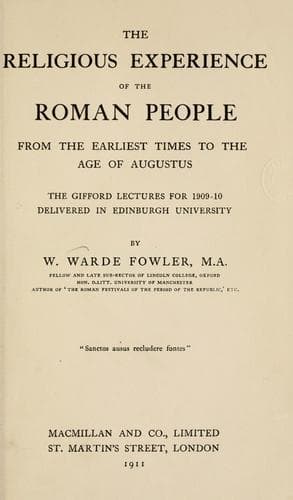
The Religious Experience of the Roman People: From the Earliest Times to the Age of AugustusFowler, W. Warde (William Warde)
Religion
The Religious Experience of the Roman People: From the Earliest Times to the Age of Augustus
Fowler, W. Warde (William Warde)
Cults -- Rome; Rome -- Religion
adorning after the manner of writers of his day; or he may have worked
in the contents of other pontifical books, _libri_ or _commentarii
pontificales_. The point for us is simply the continued activity of the
pontifex maximus in this work, which must have become almost entirely
secular in character. The notes may have been jejune, but they were
probably accurate, and free from the perversions of family vanity or
such lengthy rhetorical ornamentation as became the universal fashion
among private writers of annalistic history. They were, we may suppose,
exactly what our modern historical conscience demands. But all that is
left of them, or almost all, is the list of consuls (_fasti consulares_)
and of triumphs (_fasti triumphales_) which in their present form must,
or at least may, have been extracted from them.[582] On the whole, we
may reckon them as the most valuable work of the college; and they may
be taken as marking a growing sense of the importance of Rome and her
history, the commemoration of which is thus committed to an official
who, as an individual, had invariably served the State well, and in whom
all classes had perfect confidence.[583]
One important part of the work of the college in this century must have
been the adjustment of the civic religion of the Italian communities to
that of Rome. What deities were to be made citizens of Rome? Which were
to be left in their old homes undisturbed? No doubt many other questions
must have called for attention in religious matters after the conquest
of Italy, but this is the one of which we know most. The temple
foundations of this period have all been carefully put together (chiefly
from Livy's invaluable records) by Aust,[584] and show that there was a
certain tendency to bring in deities from outside, not so much because
they represented some special need of the Romans, corn or art or
industry, as two centuries earlier, but simply because they were deities
of the conquered whom it might be prudent to adopt. The great Juno
Regina of Veii was long ago induced by _evocatio_ to migrate to Rome;
Fors Fortuna from Etruria, Juturna from Lavinium, Minerva Capta from
Falerii, Feronia, a famous Latin goddess from Capena, Vortumnus from
Volsinii,[585] all attest the same liberal tone in religious matters
which on the whole marks the secular Italian policy of the Senate in
this period. If we had but more information about the former, we should
be able to understand the latter far better. We should like to know why
in some cases the chief deity of a community came to Rome, while in
others there is not trace of migration. The famous Vacuna of Reate, for
example, never left her home in the Apennines, possibly because she was
a kind of Vesta, who could not be spared from Reate, and was not wanted
at Rome.[586]
Public-domain text, read in full here on John Shaqi.
Reviews
Reviews
No reviews yet
Be the first to share your thoughts on this work.
Elsewhere in the archive
Join the Discussion
Join the discussion
Sign in to leave a comment or review.
Sign InorCreate an account