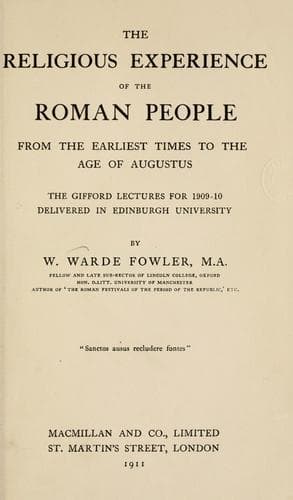
The Religious Experience of the Roman People: From the Earliest Times to the Age of AugustusFowler, W. Warde (William Warde)
Religion
The Religious Experience of the Roman People: From the Earliest Times to the Age of Augustus
Fowler, W. Warde (William Warde)
Cults -- Rome; Rome -- Religion
I will finish this lecture by illustrating briefly this renewed and
extended activity of the pontifices, so far as we can dimly trace it in
this third century B.C. Most of it is connected more or less directly
with the State religion, yet with a tendency to become more and more
secular and perfunctory; the word _cura_ would express it better than
_caerimonia_, and _caerimonia_ better than _religio_. The care of the
calendar, for example (a technical matter which lies outside my province
in these lectures), was originally of religious importance, because the
oldest religious festivals marked operations of husbandry, and these,
when fixed in the calendar, must occur at the right seasons.[578] It was
the duty of the pontifices so to adjust the necessary intercalations as
to effect this object--a duty to which they were, as it turned out,
quite unequal. But continued city life broke the connection between the
festivals and the agricultural work to which they originally
corresponded, and what was once a _cura_ of religious import became a
secular matter of which the value was not appreciated. So too with
another duty, for which both the Romans and ourselves have more reason
to be grateful to them--the recording of the leading events of national
history.
It is uncertain what prompted the college, or rather its head, to begin
making these records, though there is no doubt about the fact. But it
would be natural enough that those who had charge of the calendar, which
would necessitate some record of years for purposes of intercalation,
should go on to mark the names of the consuls and such striking events
as would make a year memorable. In any case this was what actually
happened. The pontifex maximus, we are told with precision, kept a
_tabula_, or whited board, on which these events were noted down, with
the consuls' names attached to them, or possibly a kind of almanac, made
out for the whole year, on which they could append their notes to
particular days.[579] This yearly _tabula_ was no doubt at first kept
secret, like all the pontifical documents, but sooner or later, perhaps
at the same time as the publication of the _fasti_ and _legis actiones_,
it was exposed to public view in or at the Regia.[580] This went on for
at least two centuries, and the records, which in the nature of things
must have grown in length and detail as events became more startling and
numerous, were edited in eighty books by the pontifex maximus P. Mucius
Scaevola in 123 B.C.--the year of the first tribunate of C. Gracchus.
The large number of these books has long been a stumbling-block to the
learned, for we are expressly told that the _annales maximi_, as the
records were called, were (in spite of their name) of a very meagre
character; and many conjectures have quite recently been made to explain
it.[581] But guessing is almost useless, seeing that there are no data
for it. The editor may have added matter of his own, amplifying and
Public-domain text, read in full here on John Shaqi.
Reviews
Reviews
No reviews yet
Be the first to share your thoughts on this work.
Elsewhere in the archive
Join the Discussion
Join the discussion
Sign in to leave a comment or review.
Sign InorCreate an account