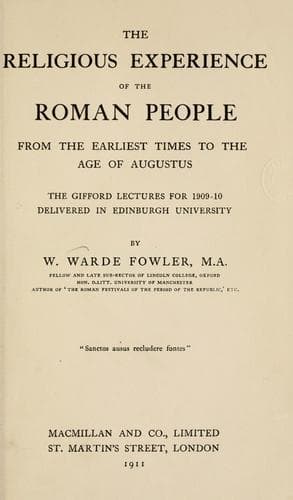
The Religious Experience of the Roman People: From the Earliest Times to the Age of AugustusFowler, W. Warde (William Warde)
Religion
The Religious Experience of the Roman People: From the Earliest Times to the Age of Augustus
Fowler, W. Warde (William Warde)
Cults -- Rome; Rome -- Religion
But we have not as yet reached what is, after all, for our purposes the
most instructive part of the work of the pontifices--I mean the archives
or memoranda (_libri_ or _commentarii_) which they kept, and from which,
indirectly, much of what I have had to say about the _ius divinum_ has
been drawn. It is here that we see the policy of maintaining the _pax
deorum_ carried to its highest point. These books contained a vast
collection of formulae for every kind of process in which the deities
were in any way concerned; here was the complete _pharmacopoeia_ of the
_ius divinum_.[591] We must remember that the pontifex maximus and his
assessors had to be ready at any moment with the correct formula for all
religious acts, whether extraordinary, like the _devotio_ of Decius or
the expiation of some startling "prodigium," or belonging to the
ordinary course of city life, such as prayers in sacrificial ritual,
_vota_ both public and private, charters (_leges_) of newly founded
temples, and so on. The idea that the spoken formula (ultimately, as we
saw, derived from an age of magic) was efficient only if no slip were
made, seems to have gained in strength instead of diminishing, as we
might have expected it to do with advancing civilisation; and the
pontifices not only responded to its importunity, but actually
stimulated it. _Vires acquirit eundo_ are words which apply well in all
ages to the passion for organisation and precision. Though we cannot
prove it, I myself have little doubt that the members of the college, or
some of them, collected and invented formulae simply for the pleasure of
doing it, and that the work became as congenial to them as the
systematisation of the law to Jewish scribes after the captivity, or as
casuistry to the confessors of the middle ages. When the art of writing
became familiar to experts, the natural and primitive desire of the
Roman to have exactness in the spoken word affected him also in his
relations with the word as written. The scribe and the Pharisee found
their opportunity. The whole public religion of the State, and to some
extent also the private religion of the family, became a mass of forms
and formulae, and never succeeded in freeing itself from these fetters.
Public-domain text, read in full here on John Shaqi.
Reviews
Reviews
No reviews yet
Be the first to share your thoughts on this work.
Elsewhere in the archive
Join the Discussion
Join the discussion
Sign in to leave a comment or review.
Sign InorCreate an account