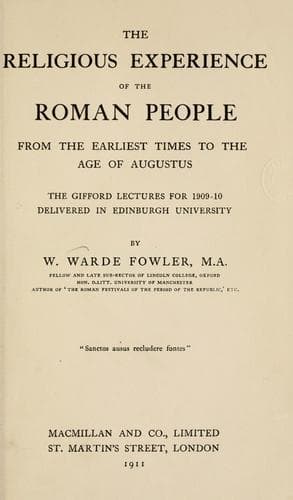
The Religious Experience of the Roman People: From the Earliest Times to the Age of AugustusFowler, W. Warde (William Warde)
Religion
The Religious Experience of the Roman People: From the Earliest Times to the Age of Augustus
Fowler, W. Warde (William Warde)
Cults -- Rome; Rome -- Religion
We can best illustrate this superfluity of priestly zeal in that strange
list of forms of invocation called _Indigitamenta_, which I have already
explained with the help of Wissowa.[592] Working upon the old Roman
animism, and the popular fondness for formulae, the pontifices drew up
those lists in the fourth and third centuries B.C., which have so
seriously misled scholars as to the genuine primitive religious ideas of
the Romans. They are in the main priestly inventions, the work of
ingenious formulators. We may even be tempted to look on them as an
attempt to rivet the yoke of priestly formalism on the life of the
individual as well as on the life of the State as a whole. But if ever
this was the intention, it was too late. A people that was beginning to
get into touch with the civilisation of Hellas could not possibly bear
such a yoke. In the last lecture we have already seen a tendency towards
emotional religion independent of the old State worship; the philosophy
of individualism was to complete the work of emancipation in the last
two centuries B.C. The old State religion remained, but in stunted form
and with paralysed vitality; Rome was the scene of an _arrested
religious development_. The feeling, the religious instinct (_religio_)
was indeed there, though latent; the Romans were human beings, like the
rest of us. But as we go on with the story we shall find that, when
trouble or disaster brought it out of its hiding-place, it was no longer
possible to soothe it on Roman principles or by Roman methods. These
methods--in other words, the _ius divinum_ as formulated by the
authorities--had been meant to soothe it, and had indeed so effectually
lulled it to sleep, that when at last it awoke again they had lost the
power of dealing with it. When the craving did come upon the Roman,
which in time of peril or doubt has come upon individuals and
communities in all ages, for support and comfort from the Unseen, it had
to be satisfied by giving him new gods to worship in new ways, gods from
Greece and the East, some of them concealed under Latin names, but still
aliens, not citizens of his own State, aliens with whom he had little or
nothing in common, who had no home in his patriotic feeling, no place in
his religious experience.[593] As I said at the beginning of the last
lecture, we must not underrate the religiousness of the Roman
character, which was never entirely lost; but the secret of its
comparative uselessness lies in this--that the natural desire to be
right with the Power manifesting itself in the universe, and to know
more of that Power, became weakened and destroyed by an over-scrupulous
attention to the means taken to realise it, and by the introduction of
foreign methods which had no root in the mental fibre of the people, and
reflected no part of its experience. Religion was effectually divorced
from life and morality.
NOTES TO LECTURE XII
Public-domain text, read in full here on John Shaqi.
Reviews
Reviews
No reviews yet
Be the first to share your thoughts on this work.
Elsewhere in the archive
Join the Discussion
Join the discussion
Sign in to leave a comment or review.
Sign InorCreate an account