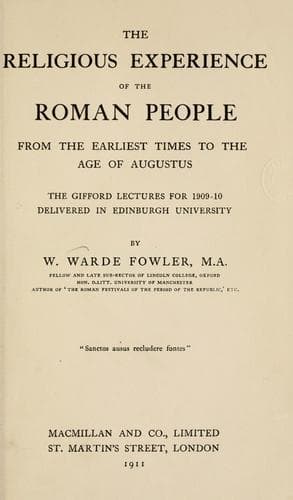
The Religious Experience of the Roman People: From the Earliest Times to the Age of AugustusFowler, W. Warde (William Warde)
Religion
The Religious Experience of the Roman People: From the Earliest Times to the Age of Augustus
Fowler, W. Warde (William Warde)
Cults -- Rome; Rome -- Religion
[574] Cic. _Brutus_, 55 "longe plurimum ingenio
valuisse."
[575] _De Orat._ iii. 33. 134.
[576] See _Dict. of Classical Biography_, _s.v._
"Coruncanius."
[577] _Nat. deor._ ii. 165. Coruncanius is mentioned as
one of those whom the gods love, if indeed they take an
interest in human affairs.
[578] See above, p. 100 foll.; and _Roman Festivals_, p.
3.
[579] Our knowledge of this _tabula_ chiefly depends on
a passage in the Danielian scholiast on Virg. _Aen._ i.
373: "ita enim annales conficiebantur. Tabulam dealbatam
quotannis pontifex maximus habuit, in qua praescriptis
consulum nominibus et aliorum magistratum, digna
memoratu notare consueverat domi militiaeque terra
marique gesta per singulos dies. Cuius diligentiae
annuos commentarios in octoginta libros veteres
retulerunt, eosque a pontificibus maximis, a quibus
fiebant, annales maximos appellarunt." The explanation
of the name is no doubt wrong; but all the rest of this
passage can be relied on; cp. Cic. _de Orat._ ii. 12.
52; Dion. Hal. i. 73, 74; Gell. ii. 28. 6; Cic. _Legg._
i. 2. 6. For the idea of the almanac, see Cichorius in
Pauly-Wissowa, _Real-Encycl._, _s.v._ "annales maximi."
[580] _Proponebat tabulam domi_, Cic. _de Orat._ ii. 12.
52. This must refer to the official residence of the
Pont. Max.; see above, p. 271.
[581] These attempted solutions of an insoluble problem
may be found in brief in Schanz, _Gesch. der roem. Lit._
i. 37. Perhaps the boldest is that of Cantorelli, that
the annales were constructed not out of the tabula but
out of the commentarii; but this is in conflict with the
passage in the scholiast on Virgil. To me the difficulty
does not seem overwhelming; events occurring "domi
militiaeque, terra marique," may have filled
considerable space, and yet have been meagre in the eyes
of the rhetoricians of the last century B.C.
[582] Schanz, _op. cit._ p. 35.
[583] The great authority of the Pont. Max. is well
shown in the story of Tremellius the praetor, who in the
middle of the second century B.C. was fined (by a
tribune?) "quod cum M. Aemilio pontifice maximo
iniuriose contenderat, sacrorumque quam magistratuum ius
potentius fuit." Livy, _Epit._ 47.
[584] _De aedibus sacris populi Romani_, p. 10 foll.
[585] Aust, _op. cit._ p. 14 foll. See also _R.F._ p.
340 foll.
[586] For Vacuna, Wissowa, _R.K._ pp. 44 and 128. She
was later, but probably without good reason, identified
with Victoria. The conjecture that she was a hearth
deity rests on the lines of Ovid, _Fasti_, vi. 305,
which I have before referred to in another context:
ante focos olim scamnis considere longis
mos erat et mensae credere adesse deos.
nunc quoque cum fiunt antiquae sacra Vacunae,
ante Vacunales stantque sedentque focos.
Public-domain text, read in full here on John Shaqi.
Reviews
Reviews
No reviews yet
Be the first to share your thoughts on this work.
Elsewhere in the archive
Join the Discussion
Join the discussion
Sign in to leave a comment or review.
Sign InorCreate an account