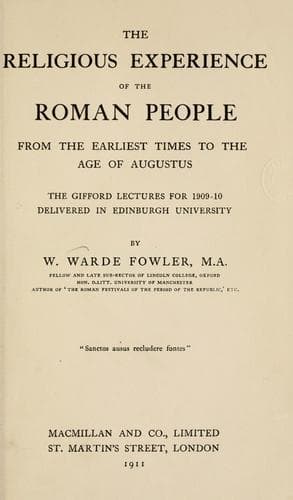
The Religious Experience of the Roman People: From the Earliest Times to the Age of AugustusFowler, W. Warde (William Warde)
Religion
The Religious Experience of the Roman People: From the Earliest Times to the Age of Augustus
Fowler, W. Warde (William Warde)
Cults -- Rome; Rome -- Religion
[566] See, _e.g._ Launspach, _State and Family in Early
Rome_, p. 256 foll. The last three chapters of this
little book, on Patria potestas, Marriage, and
Succession, will be found useful by those who cannot
enter into the many disputes and difficulties which have
arisen out of the attempts of writers on Roman law to
adjust legal ideas to the dim early history of Rome.
Binder, in his work _Die Plebs_, starts from the
improbable hypothesis that the plebs was the population
of the Latin part of the city as distinct from that
Sabine part on the Quirinal, which he believes to have
been the only patrician body; and he further believes
that the plebs lived originally under "Mutterrecht," the
patres under "Vaterrecht." Such a condition of society
would, of course, have greatly added to the pontifical
work of religious adjustment; it would have been more
than even the pontifices could have successfully
achieved.
[567] See above, note 7. Binder, _Die Plebs_, p. 488
foll., discusses, and in the main rejects, the arguments
of Pais and Lambert.
[568] So Huvelin, in a paper in _L'Annee sociologique_,
1905-6, p. 1 foll., criticised by Hubert et Mauss,
_Melanges d'histoire des religions_, p. xxiii. foll.
[569] From the religious point of view the _legis
actiones_ are best explained in Marquardt, 318 foll. Cp.
Muirhead, _Roman Law_, ed. 1899, pp. 246-7; Greenidge,
_Roman Public Life_, index _s.v._ "legis actio," and
especially p. 87.
[570] The famous passage of Pomponius is in the
_Digest_, i. 2. 2, sec. 6 (for the work of Aelius, see
_Dig._ i. 2. 2, 38) "ex his legibus ... actiones
compositae sunt, quibus inter se homines disceptarent:
quas actiones ne populus prout vellet institueret,
certas sollemnesque esse voluerunt.... Omnium tamen
harum et interpretandi scientia et actiones apud
collegium pontificum erant, ex quibus constituebatur,
quis quoquo anno praeesset privatis."
[571] Livy ix. 46 "civile ius, repositum in penetralibus
pontificum, evulgavit (Cn. Flavius), fastosque circa
forum in albo proponit, ut quando lege agi posset
sciretur." Cp. Val. Max. ii. 5. 2. _Civile ius_ is here
usually taken as meaning the procedure; but this is a
passage which may give some countenance to those who
would put the publication of the XII. Tables later than
the traditional date.
[572] For the relation of the Flamines, Vestals, and Rex
sacrorum to the pontifex maximus, see Wissowa, _R.K._
432 foll.
[573] See above, p. 283. For the eclipse, Cic. _Rep._ i.
16. 25; and for the various scientific determinations of
its exact date, Schanz, _Gesch. der roem. Lit._ vol. i.
(ed. 2) p. 37. "Ex hoc die," writes Cicero, "quem apud
Ennium et in maximis annalibus consignatum videmus,
superiores solis defectiones reputatae sunt."
Public-domain text, read in full here on John Shaqi.
Reviews
Reviews
No reviews yet
Be the first to share your thoughts on this work.
Elsewhere in the archive
Join the Discussion
Join the discussion
Sign in to leave a comment or review.
Sign InorCreate an account