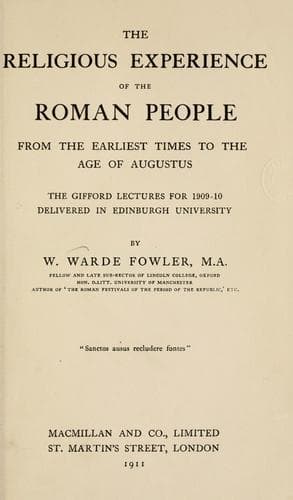
The Religious Experience of the Roman People: From the Earliest Times to the Age of AugustusFowler, W. Warde (William Warde)
Religion
The Religious Experience of the Roman People: From the Earliest Times to the Age of Augustus
Fowler, W. Warde (William Warde)
Cults -- Rome; Rome -- Religion
There is a good example of the feeling in modern Italy
in a book called _In the Abruzzi_, by Anne Macdonell, p.
275. I have experienced it in remote parts of South
Wales long ago. Moritz, the German pastor who travelled
on foot in England towards the end of the eighteenth
century, noted that even the innkeepers were constantly
unwilling to take him in. His book was reprinted in
Cassell's National Library some years ago.
[46] See the very interesting chapter in _The Origin
and Development of Moral Ideas_, vol. i. p. 570 foll.,
especially p. 590 foll. Dr. Westermarck aptly points out
that hospitality is almost universal among "rude"
peoples, and loses its hold as they become more
civilised. M. van Gennep in his recently published work,
_Les Rites de Passage_, has attempted to classify the
various rites relating to taboo of strangers; see ch.
iii., especially p. 38 foll.
[47] Jevons, _Introduction_, p. 70.
[48] Gellius x. 15. 8, "vinctum, si aedes eius
introierit, solui necessum est." (In hot countries
chains still usually, or in some degree, take the place
of bolts and bars, _e.g._ in the Soudan, as I am told by
an old pupil now in the Soudan civil service.) The
regular Latin phrase for imprisonment is "in vincula
conicere": Pauly-Wissowa, _s.v._ "carcer."
[49] Gellius, _l.c._; Serv. _Aen._ ii. 57, a curious
passage, in which the release of Sinon from his bonds by
King Priam is compared with that of the prisoner who
enters the flaminia (house of the Flamen Dialis). That
there was something in the iron which interfered with
the religious efficacy of the Flamen seems likely; cp.
the rule that he might wear no ring unless it were
broken, and have no knot about his dress. But the latter
restriction suggests that binding may have been
originally the object of the taboo (cp. Ovid, _Fasti_,
v. 432), and that the iron taboo came in with the iron
age. Appel, _de Romanorum precationibus_, p. 82, note 2,
seems so to understand it. Cp. Eurip. _Iph. Taur._ 468,
where Orestes and Pylades are unbound before entering
the temple.
Public-domain text, read in full here on John Shaqi.
Reviews
Reviews
No reviews yet
Be the first to share your thoughts on this work.
Elsewhere in the archive
Join the Discussion
Join the discussion
Sign in to leave a comment or review.
Sign InorCreate an account