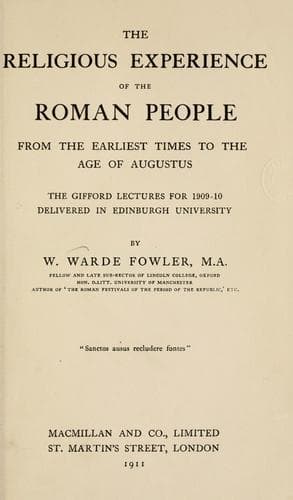
The Religious Experience of the Roman People: From the Earliest Times to the Age of AugustusFowler, W. Warde (William Warde)
Religion
The Religious Experience of the Roman People: From the Earliest Times to the Age of Augustus
Fowler, W. Warde (William Warde)
Cults -- Rome; Rome -- Religion
If we accept this distinction, as I think we may (though one school of
anthropologists is hardly disposed to do so), it is plain that magical
practices are of a totally different kind from religious practices, as
being the result of a different mental attitude towards the
supernatural; they belong to a ruder and more rudimentary idea of the
relation of Man to the Power manifesting itself in the universe. True,
they have their origin in the same kind of human experience, in the
difficulties man meets with in his struggle for existence, and his
desire to overcome these; but unlike religion, magic is a wholly
inadequate attempt to overcome them. This inadequacy was long ago well
explained by Dr. Jevons.[82] He showed that man in that early stage of
his experience did not understand the true relation of cause and effect;
that, "turned loose as it were among innumerable possible causes (of a
given effect), with nothing to guide his choice, the chances against his
making the right choice were considerable." As a matter of fact he
usually made the wrong one, and is still apt to do so. There is probably
more magic going on behind the scenes even in civilised countries, and
more especially both in Greece and Italy, than either men of science or
men of religion have any idea of. In its various forms as they are now
classified,[83] _e.g._ contagious magic, and homoeopathic magic, the
exercise of the mysterious will-power, real or imaginary, is to be found
all the world over, accompanied usually with a spell or incantation
which is believed to enforce and increase that power--a kind of
telepathy, which seems to be the psychological basis, so far as there is
one, of the whole system. In these rites the virtue resides in some
action, which, together with the spell or incantation, enforces the
desired result by calling out the will-power, or _mana_, if we adopt the
convenient Melanesian word lately brought into use. Whatever percentage
of psychological truth may lie at the root of such performances, it is
obvious that they must in the main be wholly inadequate, and must
constantly tend to pass into mere quackery and become discredited; and
it was the special function of the religious organisation of early
society to eliminate and discredit them.
Public-domain text, read in full here on John Shaqi.
Reviews
Reviews
No reviews yet
Be the first to share your thoughts on this work.
Elsewhere in the archive
Join the Discussion
Join the discussion
Sign in to leave a comment or review.
Sign InorCreate an account