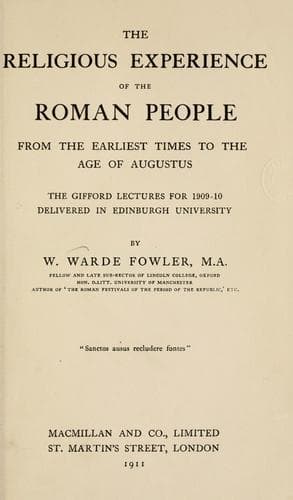
The Religious Experience of the Roman People: From the Earliest Times to the Age of AugustusFowler, W. Warde (William Warde)
Religion
The Religious Experience of the Roman People: From the Earliest Times to the Age of Augustus
Fowler, W. Warde (William Warde)
Cults -- Rome; Rome -- Religion
But it was a long stage in the evolution of society before man arrived
at a better knowledge of his relation to the Power manifesting itself in
the universe; before he reached the idea of a god or spirit realisable
and nameable, and thus capable of being addressed, placated, worshipped.
When this stage is reached, there supervenes almost always a strong
tendency to regulate and systematise the methods of address, placation,
and worship; and among some peoples, _e.g._ the Romans, for reasons
which it is by no means easy to explain, this tendency is much stronger
than among others. Wherever it has been strong, wherever these methods
of putting oneself in right relation with the Power have been
systematised by a central authority or priesthood, and thus made into
religious law, there, as we might naturally expect, the performances and
performers of magic have been most vigorously discountenanced and
outlawed. The interests of religion and its officials are wholly
antagonistic to those of magic and magicians. In civilised communities
and in historical times magic is in the main individualistic, not
social; magical ceremonies for the good of the community seem to be
confined to races in a very early stage of development. The examples on
which Dr. Frazer relies for his theory of the development of the public
magician into a king[84] are of this primitive kind, or are mere
survivals of magic in a higher stage of civilisation--such survivals as
there will always be among forms and ceremonies, of which it is man's
nature to be tenacious. But religion, once firmly established,
invariably seeks to exclude magic; and the priest does his best to
discredit the magician, as claiming to exercise mysterious powers
outside the pale of the legally recognised methods of propitiation and
worship. As Dr. Tylor observed long ago, the more civilised the race,
the more apt it is to associate magic with men of inferior
civilisation.[85] In the Jewish law, though magic was well known to the
Jews and privately practised, there is no recognition of it; the magical
books attributed to Solomon were suppressed, according to tradition, by
the pious king Hezekiah.[86] So too at Rome, where the outward forms of
religion were also very highly systematised, magic, as it seems to me,
was rigorously excluded from the State ritual, though it continued in
use in private life under certain precautions taken by the State; in the
few genuine examples of it in the rites belonging to the _ius divinum_
(_i.e._ those used and sanctioned for the purposes of the community),
it is nothing more than a survival of which the magical meaning was
unknown to the writers from whom we hear of it.
Public-domain text, read in full here on John Shaqi.
Reviews
Reviews
No reviews yet
Be the first to share your thoughts on this work.
Elsewhere in the archive
Join the Discussion
Join the discussion
Sign in to leave a comment or review.
Sign InorCreate an account