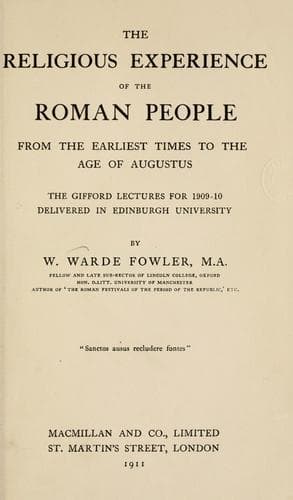
The Religious Experience of the Roman People: From the Earliest Times to the Age of AugustusFowler, W. Warde (William Warde)
Religion
The Religious Experience of the Roman People: From the Earliest Times to the Age of Augustus
Fowler, W. Warde (William Warde)
Cults -- Rome; Rome -- Religion
This parallel I owe to Dr. Frazer's wide knowledge of all such practices
among savage peoples. But this ever helpful and friendly guide, in
treating of the Jupiter Elicius concerned in this ceremony, has gone
beyond the evidence, and attributed to the Romans another kind of magic
of which I believe they were quite innocent. He has been led to this by
his theory that kings were developed out of successful magicians. In his
lectures on the early history of the Kingship[90] he maintains that the
Roman kings practised the magical art of bringing down lightning from
heaven. "The priestly king Numa passed for an adept in the art of
drawing down lightning from the sky.... Tullus Hostilius is reported to
have met with the same end (as Salmoneus, king of Elis) in an attempt to
draw down Jupiter in the form of lightning from the clouds." To support
these statements Dr. Frazer quotes Pliny, Livy, Ovid, Plutarch,
Arnobius, Aurelius Victor, and Zonaras--truly a formidable list of
authorities; but without any attempt to discover where any of these late
writers found the stories. Yet he had but to read Aust's admirable
article "Jupiter" in the _Mythological Lexicon_[91] to assure himself
that legends which cannot be traced farther back than the middle of the
second century B.C. cannot seriously be assumed to be genuinely Roman.
Pliny happens to mention Calpurnius Piso as his authority; this was the
man who is well known in Roman history as the author of the first _lex
de repetundis_ of the year 149 B.C., a good statesman, but as an
annalist much given to indulging a mythological fancy.[92] We happen to
know that he wrote with happy confidence about the life and habits of
Romulus, and a story about wine-drinking which he attributes to that
king is obviously transferred to him from some more historical
personage. Romulus would not drink wine one day because he was going to
be very busy on the next. Then they said to him, "If we all did so,
Romulus, wine would be cheap." "Nay, dear," he replied, "if every one
drank as much as he wished; and that is exactly what I am doing."[93] I
quote the story simply as a good example of the way in which Roman
historians could deal with their kings, and of the absolute necessity of
acquainting oneself with their methods before building hypotheses upon
their statements. I hardly need to add that another of Dr. Frazer's
authorities, Arnobius, informs us that he took the story from the second
book of Valerius Antias, a later writer than Piso, whose name is a
byword even with the uncritical Livy for shameless exaggeration and
mis-statement.[94]
Public-domain text, read in full here on John Shaqi.
Reviews
Reviews
No reviews yet
Be the first to share your thoughts on this work.
Elsewhere in the archive
Join the Discussion
Join the discussion
Sign in to leave a comment or review.
Sign InorCreate an account